Showing posts with label "Freeways in Washington" Panel 1998. Show all posts

Monday, October 19, 2009

Ruth Abbott - Widow of Sammie Abbott -- Dies

Was married to Sammie Abbott- artist and 1930s labor organizer who later became Mayor of Takoma Park after serving as perhaps the central figure of the local grass roots activism against the 1960s era freeway planning

Ruth Abbott
at the Franklin Street area overlook of the Metropolitan Branch RR
looking towards the U.S. Capitol Building
on un-built D.C. I-95 tour, 1997
(I-95 was not planned to run along this western side of the RR- which to the north runs directly alongside Catholic University of America,
instead being routed through residences to its east)

http://www.legacy.com/WashingtonPost/DeathNotices.asp?Page=Notice&PersonID=134546701

Ruth G. Abbott


ABBOTT RUTH GRACE ABBOTT Of Takoma Park, MD died October 14, 2009 at age 89. She was married to Mayor Sam Abbott, with whom she had three children: physician Abraham Abbott (wife Sonata); artist Susan Abbott Arisman (husband James); and writer Nancy Abbott Young. She is also survived by grandchildren: Jim Abbott, wife Alyson, daughter Ashley; Roxanna Abbott Lewis, husband Eric, son Maxwell; Nathaniel Vaughan; and Colin Arisman. Services will be held by the family. In lieu of flowers, donations may be sent in Ruth''s memory to the Public Citizen Health Research Group, c/o Dr. Sydney Wolfe, 1600 20th St., N.W., DC 20009.


Ruth Abbott at the I-95 stub
(since paved over with parking)
on un-built D.C. I-95 tour, 1997

Ruth Abbott at Barney Circle Underpass
on local highway tour 1997

SE Freeway Truncation


Glen Harper,
who favors building the ICC highway via environmentally advanced road design,
with Ruth Abbott 1998
on Glen Harper's ICC Tour

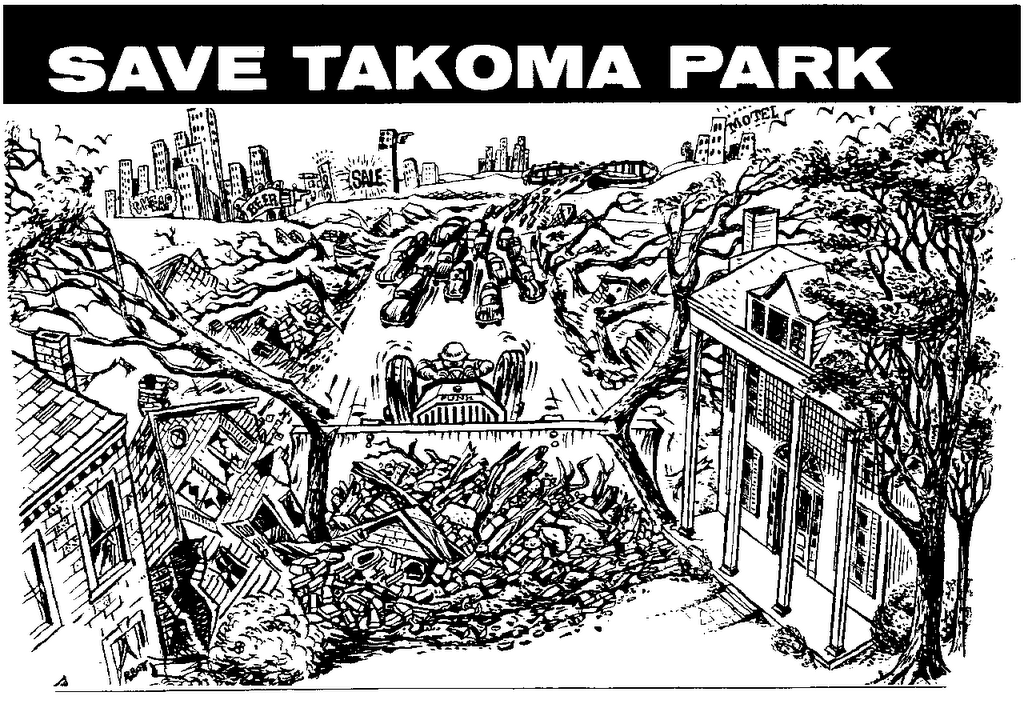
Sammie Abbott poster, November 1964


Sammie Abbott art

Looking down Cedar towards
the junction with Birch

The Abbotts were spurred to oppose the North Central Freeway - the north-south route for I-95 and I-70S in northern Washington, D.C. with the public unveiling of 'Route #11' - "Railroad-Sligo East" with its destructive and out of the way route deviation through some of the oldest areas of historic Takoma Park, Maryland,
inexplicitly disregarding the John F Kennedy Administration November 1962 proposal for a North Central Freeway strictly hugging the existing B&O [Metropolitan Branch] RR

According to Ruth, the woman who lived in that house, depicted to the right in his rendering, in 1964 had refused to sign their petition against the North Central Freeway

In 1964 the Abbotts lived on Birch,
at the very spot marked in the above 1964 report illustration with the number "320".

Afterwards, they resided on Holly
at the spot where the 1964 plan placed the northbound on and off ramps

1964 Option #11 I-70S segment leaves RR in Silver Spring


1964 Option #11 I-70S segment cuts through Takoma Park,
on longer route
through 471 houses, including the Abbott's

1964 Option #11 I-70S segment at New Hampshire Avenue


Under this 1964 plan, the North Central Freeway intercepted an I-95 Northeastern Freeway at Fort Totten
that was routed in D.C via the Fort Drive Route -- Fort Circle Park -- between Gallatin and Galloway Streets, and in Maryland via North West Branch Park


Further south, the 1964 plan's I-95 segment ran fully east of the RR's parallel industrial belt, displacing over 200 dwellings
in the Turkey Thicket neighborhood
between Taylor Street and Michigan Avenue NE,
and
69 south of Monroe Street and west of 10th Streets NE, plus
the historic 1837 vintage Brooks Mansion


1963-1964 Study
37 route options


JFK 1962 Plan-
freeways and rail transit

This plan proposed that the North Central Freeway tightly hug the existing railroad to reduce its local impacts, yet was entirely disregarded -- without explanation -- by the 1963-64 North Central Freeway study with its 37 routes all over the NE map inflaming local opposition. It was not until late 1966 that a supplementary report was released that followed the 1962 plan.

1966 Supplementary Study
B&O Route North Central Freeway
(officials waffled on this, refusing to commit
to this far less impactive 1966 plan

while continuing consideration of the 1964 plan
as late as 1968!)
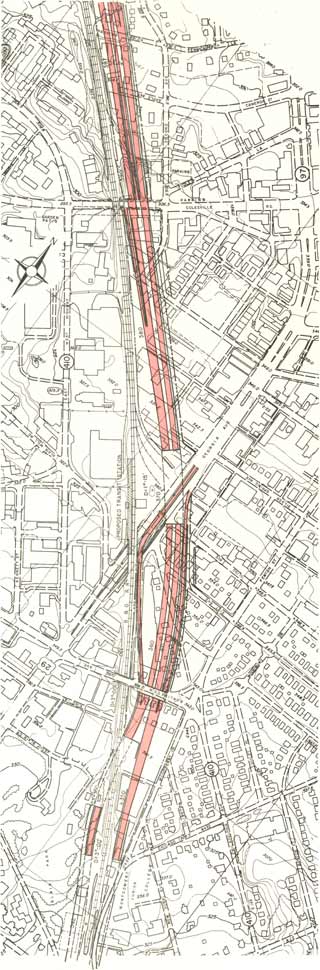

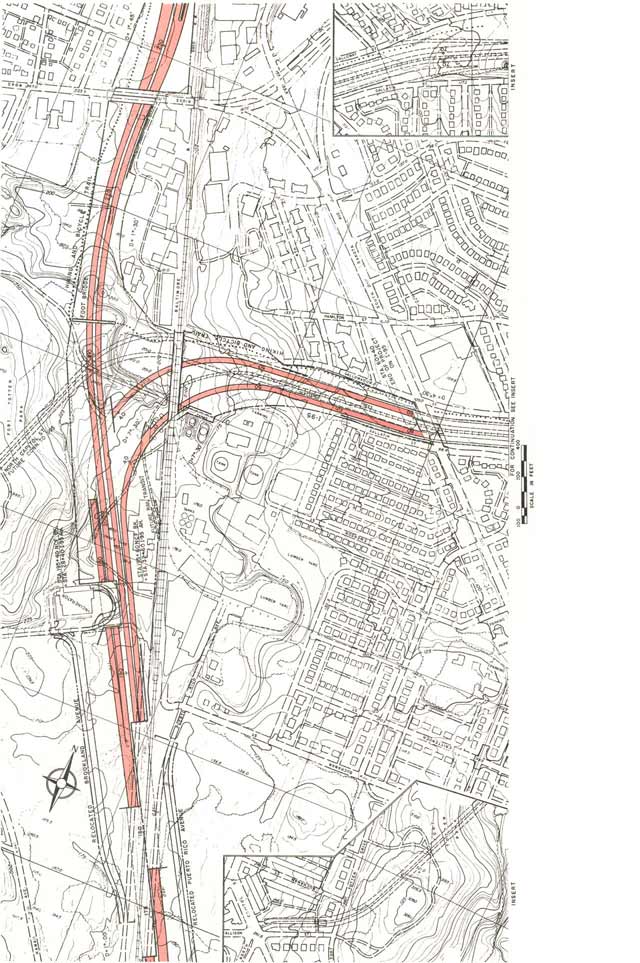
1966 B&O North Central Freeway I-70S segment in Silver Spring, Maryland
with cut and cover tunnels alongside Montgomery Community College


1966 B&O Route North Central Freeway
I-70S segment
3 lanes hugging each side of the RR
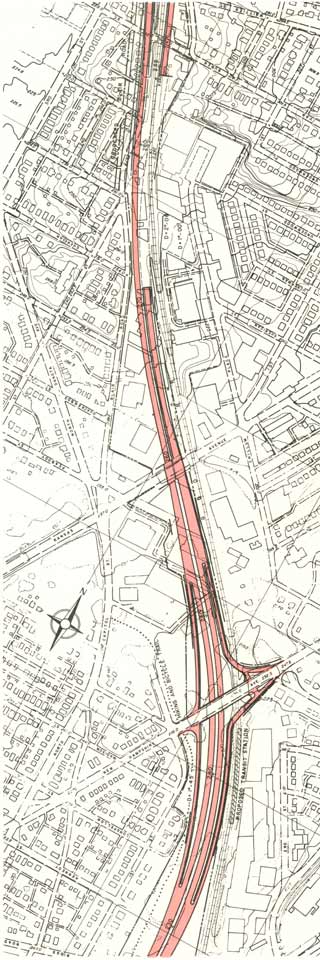


1966 B&O Route North Central Freeway
I-70S segment
at New Hampshire Avenue


1966 B&O Route North Central Freeway,
retains I-95 interception at Fort Totten (with added jog of route westwards further into Fort Totten Park), with Fort Drive-Northwest Branch Park Route
for I-95 connection to the stubs at the Capital Beltway


1966- Proposed 'air rights' cover,
I-95 segment
alongside Catholic University of America-
disappears from subsequent 1971 version;

1966 B&O Route North Central Freeway instead employs industrial zone along RR's east side,
entirely sparing Turkey Thickett and Brooks Mansion, limiting local residential displacement to the 69 south of Monroe and west of 10th Street. By 1970, the plan is further refined (either by running even closer to the RR or via substituting a sloped embankment with a vertical retaining wall) to reduce this number from 69 to 34, with the 1971 proposal showing this highway in a cut and cover tunnel from a few hundred feet north of Michigan Avenue, to just south of Rhode Island Avenue, with replacement housing atop.

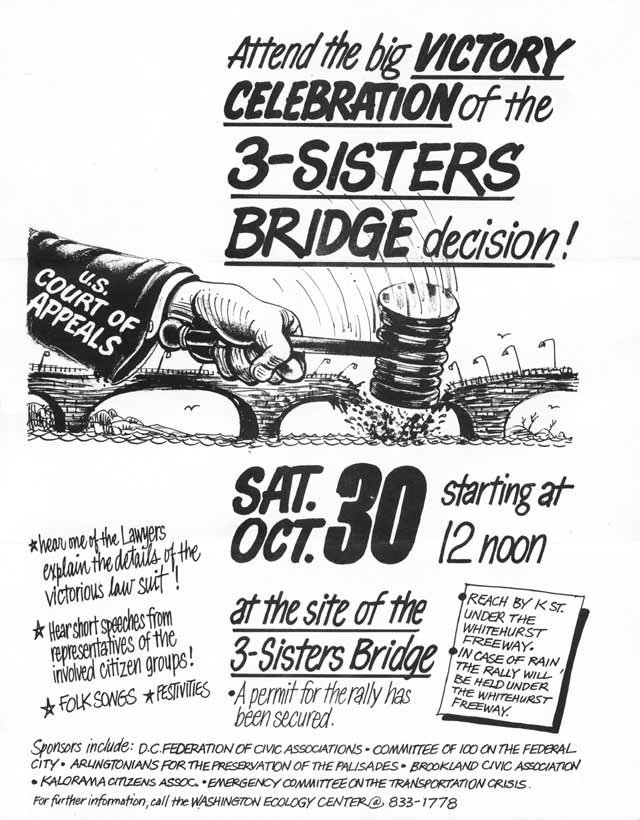
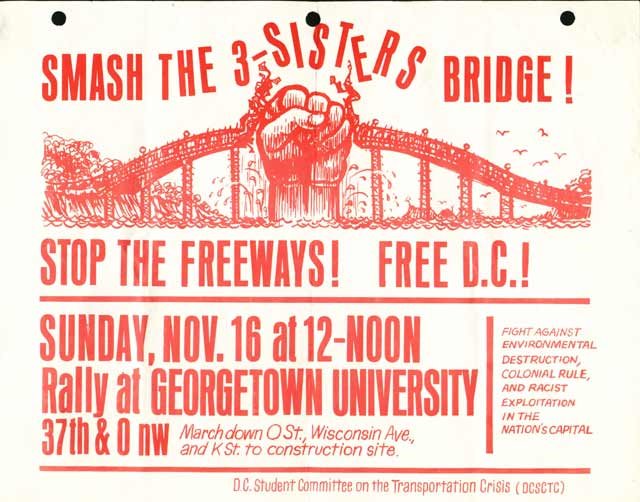
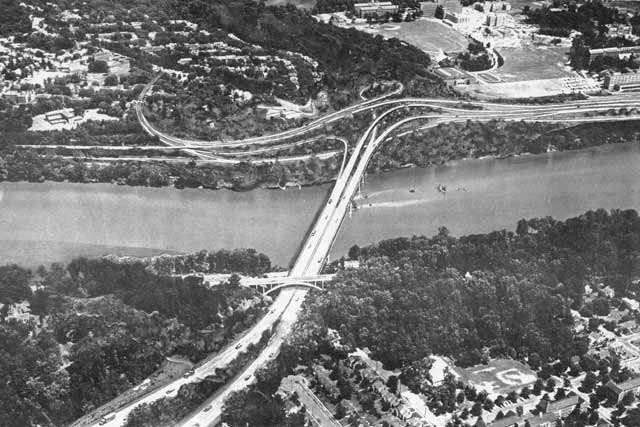
The proposed I-266 'Three Sisters Bridge'
pointing at Georgetown University

Notably, it was this area of Brookland near Catholic University of America -- the 69 houses reduced to 34 by the 1970 revision, along with the Three Sisters Bridge next to Georgetown University -- that apparently received the ECTC's greatest protest activity during the late 196s-early 1970s, as opposed to the 600+ targeted by un-built D.C. I-95's southernmost segment -- the North Leg East that would connect to the existing Center Leg (3rd Street Tunnel) at New York Avenue and 4th Street.

1971 B&O Route North Central Freeway,
I-95 segment
Washington, D.C. Brookland - CUA area
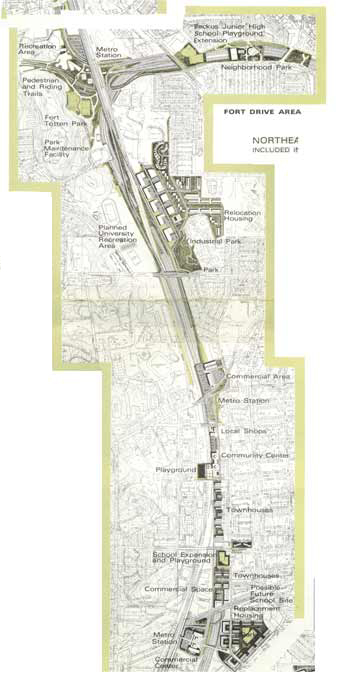
1971- retains the I-95 Northeastern Freeway Fort Drive-Northwest Park route

1971- alternative of I-95 Northeastern Freeway via New Hampshire Avenue-PEPCO Route- see 1973 Maryland report
connecting through the field of the Order of the Eastern Star home


'The Freeway Fighter's Primer' ECTC June 1971


'An Open Letter to Every Member of the U.S. Senate and House of Representatives'
Reginald H. Booker, ECTC, June 23, 1968


1970 ECTC poster-
shows 1966-71 North Central Freeway with the 1955- version of the Inner Loop
with the cross-town I-66 North Leg via an open trench along Florida Avenue and U Street NW eastwards to New Jersey Avenue past which it transitions as a raised berm. Though dated 1970, the poster does NOT show the I-66 K Street Tunnel alternative proposed by U.S. National Capital Planning Commission's Elizabeth Rowe in 1965, and then already the official preference of Federal and D.C. officials -- with the D.C.Department of Public Works being the holdout -- and included as an east-west alternative to the SE/SW Freeway, even after the deletion of the north-south North Central/Northeast Freeway

anti-freeway ECTC poster (excerpt)
dated January 1970,
with Sammie Abbott as publicity director
and, as one of its Chairmen- Marion Barry,
who later became D.C. Mayor, and
in 1996 advanced the 1st official proposal since the 1970s
for
extending I-395 via a new tunnel design

Ruth attended the 1998 D.C. Historical Society panel Freeways in Washington- see a review.

1998 D.C. Historical Society panel Freeways in Washington
Keith Melder, (author "City of Magnificent Intentions"), moderator, with
Angela Rooney, Douglas Willinger and Jeremy Korr


Angela Rooney, Douglas Willinger, and Jeremy Korr


audience with Ruth Abbott (center)


Sunday, February 04, 2007

Review of 1998 panel "Freeways in Washington"

Newsgroups: dc.general, dc.driving, misc.transport.road, alt.planning.urban, misc.transport.urban-transit

From: sarcas...@erols.com.nyetspam

Date: 1998/11/01

Subject: Re: Freeways in Washington panel/Historical Society of Washington, D.C. conference

On Sun, 18 Oct 1998 17:39:45 -0400, Douglas Andrew Willinger wrote:

>25th ANNUAL CONFERENCE ON WASHINGTON, D.C. HISTORICAL STUDIES,
>October 29-31, 1998

A quick report on the above. Interesting, but mostly depressing. Jeremy Korr, a doctoral candidate at the University of Maryland, did an outstanding job laying out the history of the now dead I-70 and I-95 segments in NE Washington. Should be required reading for DC area commuters, as he spelled out, in even-handed yet entertaining terms, the dates, players, and order of battle of these roads. His slides included a number of flyers that I've never seen before; my favorite was the ECTC (Emergency Committee on the Transportation Crisis) "We don't want your commuters!" tag line -- not as catchy as "White Men's Roads through Black Men's Neighborhoods," (as we all know, there are no minorities in PG county) but pretty much sums up not only the opinion of the time, but was an uncannily accurate prediction -- the jobs (and the commuters) went elsewhere. Of course, DC still has a traffic problem as the commuters cut through the city en route from their homes in Md to jobs in VA (or vice versa).

Mr. Korr was followed by our own Douglas Willinger, who, in rather agonizing detail, laid out some of the literally dozens of alignments that were at one time or another planned for DC. The most horrifying was of course the Rock Creek Park alignment. By 1971, as we know, the alignment was almost entirely along mostly abandoned industrial corridors, and had gone from taking 4,500 homes to a whopping 69. But of course those 69 homes were worth saving, as they are today worth 1,017,391,304 each (225,000 commuters at $10/hr for 30 years spending an extra half hour on the beltway). The bargain of the century, in fact, in that you can buy one today (well, one that's remaining, several have been torn down anyway) for about $75,000. Not a bad return!

Doug ran short on time and thus was unable to spend much time showing us slides of the "neighborhood" of abandoned warehouses and empty rail yards that were preserved.

Doug was followed by Angela Rooney, a lady from the Brooklands area who was an activist during the era. She spent most of her time plugging her friend Helen Leavett's long out-of-print book, "Superhighway, Superhoax," which is an excellent work if you believe that we'll run out of gas in 1975. Ooops. She also entertained us with stories about how the FBI was out to get her and her ECTC cronies, and how the newspapers and media in general were interested only in silencing these fine citizens. She mentioned that they never did anything illegal, two minutes before telling us how a few of them got arrested during protests -- ahem -- but had little mention of Marion Barry's formula for burning down suburban houses in retaliation for those lost to wrecking ball in DC. Another interesting story was about a fantasy road that has never existed on any master plan for DC, with a highway being tunneled under the Lincoln Memorial. She mentioned that cars and Metro were not the answer to our transportation problems, but rather some unnamed "multimodal" system consisting of, one presumes, Star-Trek type transporters. No doubt the FBI is suppressing that technology as well. Strangely, she was silent about the homes that have already been lost in Springfield VA for the I95 widening, as well as the hundreds of apartments that will be razed in Alexandria, all due to the Beltway's being overburdened due to the cancellation of a through-DC I95. I suppose White Men's roads through Hispanics' Apartments is okay.

The "moderator" was Washington historian Keith Melder, who did precious little moderating, but who could be heard on WAMU last week presenting an extraordinarily one-sided interview about the history of the roads -- a nice touch was shouting over the traffic near 395 for the first segment, as he and the interviewer surveyed southwest DC, lamenting the lost neighborhoods -- strangely enough leaving out the fact that most of SW was razed as part of a comprehensive urban renewal project, and only a small section for the soutwest freeway. He and his biased interviewer then traveled to Brooklands, and failed to note that the Metro Red line splits the neighborhoods as effectively as the SW Freeway, followed by WAMU engineers punching in bird chirping soundtracks to counter the traffic noise in the first segment.

I'm glad I went. First, I got to look into the face of the devil herself. Second, I got to see some of the old-timers from that era applauding the presentations, proud of how they destroyed DC. No doubt the 40% drop in population, couple with a 50% drop in employment in the last 30 years is quite an achievement, especially coupled with the unprecedented growth in the surrounding regions. Third, I came to realize that my lofty goals in discussing on these very forums ways to revitalize and save DC are futile -- the residents of Hades would rather sweat than listen to the hammering of workers as the air conditioning vents come in.

"We don't want your commuters!" Who am I to argue with that?

--------
> B E N T L E Y < st="on">Mt. Vernon bike trail
www.access.digex.net/~bentley/remove-this-bot-blocking-part


A Sampling of Attitudes Towards D.C. I-95

A Sampling of Attitudes Towards D.C. I-95


Being the historian of Washington, D.C.’s un-built highway system I have encountered a broad spectrum of attitudes in my years on the topic.

A good example of this was canvassing to publicize the then upcoming Freeways in Washington panel at the Washington, D.C. Historical Society, held October 30, 1998, 2:00-3:30 PM in the basement of Martin Luther King Library. I appeared on this panel with Jeremy Korr (University of Maryland) and Angela Rooney; it was moderated by Keith Melder, author of City of Magnificent Intentions: A History of the District of Columbia.

As part of its promotion I was given a stack of posters advertising this event; it showed a group of anti freeway protesters on the steps of the U.S. Capitol building, cir. 1970. (When I get my scanner working again or locate an existing scan, I will add it to this post.)

I naturally had to take these posters to a variety of places. One of these of course being at the I-95 stubs or “stumps” immediately inside the I-495 Capital Beltway, at a construction trailer in the higher elevation area south of the current parking lot, with two Maryland Department of Transportation employees. The older guy – late 50s -- was uninterested: it will never happen; the other – late 20s -- though seemed inspired when I pointed out the significance of that location: hmm that makes sense. Ah the juxtaposition of embitterment and of logic.

In the places in downtown Brookland I went, I best remember the barber shop and a hardware store. The men in the barber shop cried out could they please tear down some houses to build that much needed highway and others; one guy there even said that they could tear down “half” the homes in the city to serve D.C.’s traffic flow; I assured them that would not be necessary as a full system would require a tiny percentage. The hardware store guy took a look at the poster I was distributing and asked me if it was one of those stupid highly generalized anti-highway events. I replied that it was not – at least my presentation – though others there will try to turn it into one. Wow! I found the strongest support for urban freeways in the urban areas, with the men in that barber shop being African-American. Right in downtown Brookland, D.C., reported hotbed of the doctrinaire anti freeway dogma of “No White Man’s Roads Through Black Man’s Homes.” I think that the opposition was due to the reality that the 1963-64 freeway plans were disproportionately excessive, such as with the proposed destruction of Brooks Mansion, the Turkey Thicket neighborhood and the all new swath through Takoma Park for the I-70S segment, taking 471 dwellings in the one mile or so segment via an all new swath through Takoma Park, Maryland, for a longer route for I-70S then the canceled Northwest Freeway would have done in far upper NW, 74 according to a 1957 study, from the Maryland line to just south of a Tenley Circle Underpass (and continuing via Archibald-Glover Park, alas without there ever being consideration of a tunneled route).

Of course, since D.C. I-95 was not built, I would also come across others at various times, who were quite anti

One was an individual from Maryland in the National Motorists Association who testified with me and others before a committee of the Maryland legislature sometime in the early or mid 1990s about a bill to raise the maximum speed limit in that state from 55 to 60 mph. His response to the idea of building DC I-95 was a hysterical rant about demolishing or destroying Brookland, never mind the open areas along the railroad and the low number of residential displacement (34 under the 1970-71 plan), nor the idea of it there as a cut and cover tunnel. I suspect that he is not very familiar with the route and, given his hysterical response, was under the influence of misinformation.

Others of course were some of the surviving anti freeway activists of the 1960s and 1970s. A pair that I met in February 1998 through a visit to their house was Angela Rooney and her husband Thomas, who worked at CUA. Both who were activists against building any D.C. urban highways in the 1960s and 1970s. These people, or at least Angela, were so anti-road as to even oppose the WMATA Red Line- making me wonder why they ever moved to Brookland which has had the railroad since about 1863.

Another anti was Mark Rabinowitz, who had a web site against the Maryland Inter County Connector, and a small group of his house mates at a Georgia Avenue group house where I first met him in 1996. They were against D.C. I-95 even as a park covered tunnel built upon an existing railroad industrial corridor. They were also against any highways. Period. Whether urban or rural.

Another is Stewart Schwartz, who was misinformed about the feasibility of D.C. I-95, including just how few homes it would displace (with the proper D.C. I-95 design); he was likely so misinformed by those who hired him to be the Executive Director of the “Coalition for Smarter Growth”. This organization has its address at 4000 Albermarle Street NW in DC - right next to the 1957-59 Northwest Freeway alignment just north of Tenley Circle! To his credit, Schwartz has endorsed the idea of covering segments of freeways to improve local connectivity. However, his opposition at least seemed to be based upon such misinformation, in contrast to the following I-95 opponents who embodied the highly generalized attitude of pushing the highways away with far less conversation.

These were a group of black-clothed priests that attended my June 5, 2005 presentation near Catholic University of America, at the Archbishop Carroll High School through the D.C. NE Historical Society. My presentation was "The Never-Built Freeways of Northeast D.C.: The Plans and the Controversy, Part I" by Douglas A. Willinger of the Takoma Park Highway Design Studio. IIRC, these men were identified to me as Jesuits: members of the Jesuit Order, established by Ignatius Loyola in 1543 to counter the Protestant Reformation, via strategizing to further and expand the power of the Vatican/Roman Catholic Church. (If these men were with another Catholic Order I would appreciate hearing so through this post’s comments feature). I remember two of these men in particular, one white haired elderly, described to me as liking to jump on the bandwagon rather then think for himself, and a young, dark haired, reddish complexion one – too young to have been more then a child when D.C. I-95 was canceled in 1968-1973 – who appeared to me to be of mixed Irish and German ancestry. It was he who expressed the astonishment that they were actually going to run I-95 through Washington, D.C., as if that was somehow unfathomable. He did not appear too pleased to hear me discuss its feasibility, even as I acknowledged the shortcomings of the earlier designs (and that I felt it was right to stop those earlier specific plans, such as the 1964 plan’s demolition of Brooks Mansion).

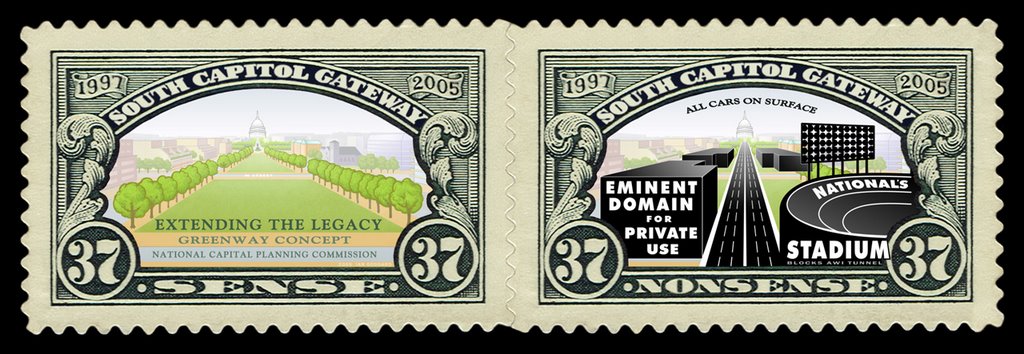
Figuring that these men had an interest in what they would likely call “social justice” matters, I ended my laptop projection presentation with my own example of activism: the South Capitol Street/ Frederick Douglass Mall, and its desecration by the atrociously placed Nationals Ball Park Stadium, with the visual image of the stamp-pair that I had created with Ian Goddard in early 2005. I looked forward to an interesting discussion.
Instead there was only a cold silence.

Such so far reflects the general attitude of the authorities towards any urban freeways.


A Beholden Doctrine