Showing posts with label Stewart Schwartz. Show all posts

Thursday, June 30, 2011

Bruce Depuyt's Jesuitical Spin

on dealing with the Washington, D.C. region's worsening traffic problems


A June 21, 2011 presentation moderated by Bruce Depuyt, featuring David Alpert, creater of the blog Greater Greater Washington, Stewart Schwart of the Coalition for Smart Growth, and Richard Parsons of the Suburban Maryland Transportation Alliance; Depuyt askes what needs to be done to fix the Washington D.C. region's notoriously bad traffic problem, yet does so with a misleading spin, from the very start.

Those promoting traditional method”
“A radically different approach to growth and transportation challenges”
Depuyt’s description, as applied, is factually erroneous- unfairly against Richard Parsons.

Rather, it should be described as those promoting a full mix of three main options:

1) expanding the WMATA transit system,
2) constructing more high density mixed used real estate development near such WMATA, and
3) expanding the highway system;

Versus those promoting only 1) and 2) but not 3), disregarding that is precisely what’s been done for the past 30+ years where it naturally is going to matter the most with the greatest ripple effects.

Yes, “traditional” – in the context of Washington D.C. regional planning – means NOT building any new major vehicular roads, a tradition of the last 30 some years, and of greater densification within the urban core/near WMATA transit stations, a tradition of the last 14 or so years. “radically different” could mean either abandoning that, or it can mean retaining that along with starting a supplementary stage of additions to the major roads network, including improved interchanges/intersections and all new links, for transit and highways.

From the spin, one would image that the Washington, D.C. region, which has got to include Washington D.C. has been building new grade seperated highways (freeways) for decades.

Yet it is within the Beltway and Washington D.C. itself where the region has suffered with the 'de-mapping' of most of the planned freeway network.

The Washington, D.C. area transportation system can be thought of as a giant carriage, with two radically different types of wheels on its left and right sides: one has a complete outer tread but with a broken and largely missing center hub, with a huge gap in its radial spokes; the other has virtually no outer tread, but with numerous more and more evenly distributed radial spoke; sitting between are a body polite telling u to simply move laterally towards the side with the latter type of wheel-and imagine the increasingly likelihood of getting shafted.

That was the result of the great transportation planning controversy of the 1960s and 70s.

We were promised both wheel-sets- a WMATA rail transit network, and a freeway-highway network. Though it was not offered with a transit outer tread – a beltway rail, offering that only for the freeway network owing to the relative little demand – it offered both WMATA rail and freeway radial spokes, as seen by November 1962.


JFK's Washington, D.C. Transportation System- November 1, 1962

http://wwwtripwithinthebeltway.blogspot.com/2006/12/1962-national-capital-transportation.html

Anyone remotely familiar with the region knows this is largely the WMATA system, but behold, much of the freeway system is simply missing- a fact testified daily by the sights of the numerous freeway truncations within and near Washington. Consequently, as a result of the mis-planning of the mid 1960s and later, there are no continuous freeway routes, encouraging thus the traffic to entirely spill onto the surface streets and/or take continuous yet longer freeway routes, primarily upon the Capital Beltway which goes around Washington, D.C. barely piercing its southernmost disconnected tip in Alexandria, Virginia’s Jones Point Park. This wastes a significant amount of time, discourages commerce, and does so unnecessarily from standpoints of local neighborhood preservation and costs, owing to the existing right of ways – such as the conveniently located 250 foot wide PEPCO power line corridor for extending I-95 within the Beltway – as well as the use of cut and cover tunnels, not only such beneath existing surface streets, but also to bring it back together where now bisected by surface and elevated rail .

Yet Depuyt with a straight face asks "To what extent do you envision some type of pushback against a more roads is better approach to solving our regions transportation problem?"

Depuyt sounds utterly ignorant of the history of Washington, D.C. and inside the Beltway highway planning -- we all know that the Washington Post loves to continually lie about it again and again and again -- and that the spin is assigned.

The dynamics suggest something highly hierarchical, with key properties along key routes, such as this, and hardly loyal to the principle of truth.

More on this:
A debate on the region’s transportation priorities

Sunday, February 04, 2007

A Sampling of Attitudes Towards D.C. I-95


Being the historian of Washington, D.C.’s un-built highway system I have encountered a broad spectrum of attitudes in my years on the topic.

A good example of this was canvassing to publicize the then upcoming Freeways in Washington panel at the Washington, D.C. Historical Society, held October 30, 1998, 2:00-3:30 PM in the basement of Martin Luther King Library. I appeared on this panel with Jeremy Korr (University of Maryland) and Angela Rooney; it was moderated by Keith Melder, author of City of Magnificent Intentions: A History of the District of Columbia.

As part of its promotion I was given a stack of posters advertising this event; it showed a group of anti freeway protesters on the steps of the U.S. Capitol building, cir. 1970. (When I get my scanner working again or locate an existing scan, I will add it to this post.)

I naturally had to take these posters to a variety of places. One of these of course being at the I-95 stubs or “stumps” immediately inside the I-495 Capital Beltway, at a construction trailer in the higher elevation area south of the current parking lot, with two Maryland Department of Transportation employees. The older guy – late 50s -- was uninterested: it will never happen; the other – late 20s -- though seemed inspired when I pointed out the significance of that location: hmm that makes sense. Ah the juxtaposition of embitterment and of logic.

In the places in downtown Brookland I went, I best remember the barber shop and a hardware store. The men in the barber shop cried out could they please tear down some houses to build that much needed highway and others; one guy there even said that they could tear down “half” the homes in the city to serve D.C.’s traffic flow; I assured them that would not be necessary as a full system would require a tiny percentage. The hardware store guy took a look at the poster I was distributing and asked me if it was one of those stupid highly generalized anti-highway events. I replied that it was not – at least my presentation – though others there will try to turn it into one. Wow! I found the strongest support for urban freeways in the urban areas, with the men in that barber shop being African-American. Right in downtown Brookland, D.C., reported hotbed of the doctrinaire anti freeway dogma of “No White Man’s Roads Through Black Man’s Homes.” I think that the opposition was due to the reality that the 1963-64 freeway plans were disproportionately excessive, such as with the proposed destruction of Brooks Mansion, the Turkey Thicket neighborhood and the all new swath through Takoma Park for the I-70S segment, taking 471 dwellings in the one mile or so segment via an all new swath through Takoma Park, Maryland, for a longer route for I-70S then the canceled Northwest Freeway would have done in far upper NW, 74 according to a 1957 study, from the Maryland line to just south of a Tenley Circle Underpass (and continuing via Archibald-Glover Park, alas without there ever being consideration of a tunneled route).

Of course, since D.C. I-95 was not built, I would also come across others at various times, who were quite anti

One was an individual from Maryland in the National Motorists Association who testified with me and others before a committee of the Maryland legislature sometime in the early or mid 1990s about a bill to raise the maximum speed limit in that state from 55 to 60 mph. His response to the idea of building DC I-95 was a hysterical rant about demolishing or destroying Brookland, never mind the open areas along the railroad and the low number of residential displacement (34 under the 1970-71 plan), nor the idea of it there as a cut and cover tunnel. I suspect that he is not very familiar with the route and, given his hysterical response, was under the influence of misinformation.

Others of course were some of the surviving anti freeway activists of the 1960s and 1970s. A pair that I met in February 1998 through a visit to their house was Angela Rooney and her husband Thomas, who worked at CUA. Both who were activists against building any D.C. urban highways in the 1960s and 1970s. These people, or at least Angela, were so anti-road as to even oppose the WMATA Red Line- making me wonder why they ever moved to Brookland which has had the railroad since about 1863.

Another anti was Mark Rabinowitz, who had a web site against the Maryland Inter County Connector, and a small group of his house mates at a Georgia Avenue group house where I first met him in 1996. They were against D.C. I-95 even as a park covered tunnel built upon an existing railroad industrial corridor. They were also against any highways. Period. Whether urban or rural.

Another is Stewart Schwartz, who was misinformed about the feasibility of D.C. I-95, including just how few homes it would displace (with the proper D.C. I-95 design); he was likely so misinformed by those who hired him to be the Executive Director of the “Coalition for Smarter Growth”. This organization has its address at 4000 Albermarle Street NW in DC - right next to the 1957-59 Northwest Freeway alignment just north of Tenley Circle! To his credit, Schwartz has endorsed the idea of covering segments of freeways to improve local connectivity. However, his opposition at least seemed to be based upon such misinformation, in contrast to the following I-95 opponents who embodied the highly generalized attitude of pushing the highways away with far less conversation.

These were a group of black-clothed priests that attended my June 5, 2005 presentation near Catholic University of America, at the Archbishop Carroll High School through the D.C. NE Historical Society. My presentation was "The Never-Built Freeways of Northeast D.C.: The Plans and the Controversy, Part I" by Douglas A. Willinger of the Takoma Park Highway Design Studio. IIRC, these men were identified to me as Jesuits: members of the Jesuit Order, established by Ignatius Loyola in 1543 to counter the Protestant Reformation, via strategizing to further and expand the power of the Vatican/Roman Catholic Church. (If these men were with another Catholic Order I would appreciate hearing so through this post’s comments feature). I remember two of these men in particular, one white haired elderly, described to me as liking to jump on the bandwagon rather then think for himself, and a young, dark haired, reddish complexion one – too young to have been more then a child when D.C. I-95 was canceled in 1968-1973 – who appeared to me to be of mixed Irish and German ancestry. It was he who expressed the astonishment that they were actually going to run I-95 through Washington, D.C., as if that was somehow unfathomable. He did not appear too pleased to hear me discuss its feasibility, even as I acknowledged the shortcomings of the earlier designs (and that I felt it was right to stop those earlier specific plans, such as the 1964 plan’s demolition of Brooks Mansion).

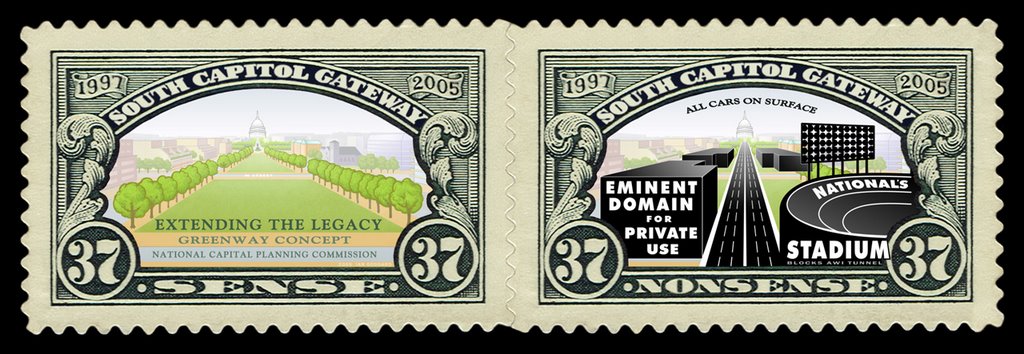
Figuring that these men had an interest in what they would likely call “social justice” matters, I ended my laptop projection presentation with my own example of activism: the South Capitol Street/ Frederick Douglass Mall, and its desecration by the atrociously placed Nationals Ball Park Stadium, with the visual image of the stamp-pair that I had created with Ian Goddard in early 2005. I looked forward to an interesting discussion.
Instead there was only a cold silence.

Such so far reflects the general attitude of the authorities towards any urban freeways.


A Beholden Doctrine