Showing posts with label ECTC. Show all posts

Thursday, August 25, 2016

Anti Freeway/Anti WMATA Rail Transit System Activist Angela Rooney Dead at 96

of the Emergency Committee on the Transportation Crisis (ECTC)


Rooney not only opposed the North Central Freeway,
but also the planned/built WMATA rail transit system


Angela Rooney, Douglas Willinger, Jeremy Korr
1998 'Freeways in Washington' panel
D.C. Historical Society Conference


ECTC - Emergency Committee on the Transportation Crisis names, 
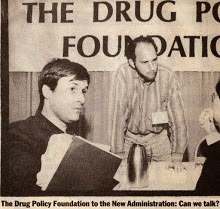
on 'Freeway Cancer Hits Washington, D.C.' poster partially visible in the preceding photo
with Angela Rooney listed among its 'Secretarial Committee' ,
with R.H. Booker as Chairman, Marian Barry as Vice Chairman, 
and Samuel Abdullah Abbott as Publicity Director

http://www.legacy.com/obituaries/washingtonpost/obituary.aspx?eid=sp_ommatch&fhid=17003&n=angela-l-rooney&pid=181167773

On Saturday, August 20, 2016 of Washington, DC. Beloved wife of 60 years to Thomas P. "Tom" Rooney; wonderful mother of Kate Rooney Miskovsky and the late Christopher Rooney; loving grandma of Alex, Megan, Lauren Miskovsky and Alexis Rooney; sister of the late William Bayer and Joan Severin. Survived by her daughter-in-law, Kimberley Rooney; as well as numerous nieces, nephews, cousins, friends and neighbors. Angela enjoyed a long and extraordinary life. She was a devoted wife and mother, who also found time to pursue diverse careers, and her three main passions; art, acting, and activism. After receiving her BFA from the Tyler School of Art at Temple University, she served three years with the American Red Cross during WWII. Angela worked for the NY Botanical Society and the DuPont Company. She moved to Washington, DC, in the 1950s taking advanced acting classes at Catholic University, which led to a TV job on the Mark Evans Show. Following her marriage to her devoted husband Tom, they settled into Brookland in DC. She soon became involved in many civic organizations, often as a co-founder including the Emergency Committee on the Transportation Crisis, NCTC, UNECC, Preservation of the Brooks Mansion, The McMillan Reservoir, Trash Transfer station issues, and a staunch supporter of the Metro System. During these years she also worked as a manager of the Kennedy Center Theater Chamber Players and special events at the National Gallery of Art. She received numerous distinguished awards for her dedication to the city and her community. A Funeral Mass will be offered at St. Anthony''s Catholic Church, 1029 Monroe Street, NE, Washington, DC on Friday, August 26 at 10 a.m. Interment Mt. Olivet Cemetery. In lieu of flowers, memorial contributions may be made in her name to Capital Caring Hospice, 2900 Telestar Court, Falls Church, VA 22042.
Jeremy Korr of the University of Maryland and myself appeared on the 1998 D.C. Historical Society conference panel 'Freeways in Washington' with Angela Rooney, and moderated by Keith Mulder.
http://wwwtripwithinthebeltway.blogspot.com/2007/02/review-of-1998-panel-freeways-in.html
https://groups.google.com/forum/#!topic/misc.transport.urban-transit/XGUztwmeBUA
Doug was followed by Angela Rooney, a lady from the Brooklands area who was an activist during the era. She spent most of her time plugging her friend Helen Leavett's long out-of-print book,"Superhighway, Superhoax," which is an excellent work if you believe that we'll run out of gas in 1975. Ooops. She also entertained us with stories about how the FBI was out to get her and her ECTC cronies, and how the newspapers and media in general were interested only in silencing these fine citizens. She mentioned that they never did anything illegal, two minutes before telling us how a few of them got arrested during protests -- ahem -- but had little mention of Marion Barry's formula for burning down suburban houses in retaliation for
those lost to wrecking ball in DC. Another interesting story was about a fantasy road that has never existed on any master plan for DC, with a highway being tunneled under the Lincoln Memorial. She mentioned that cars and Metro were not the answer to our transportation
problems
, but rather some unnamed "multimodal" system consisting of, one presumes, Star-Trek type transporters. No doubt the FBI is suppressing that technology as well. Strangely, she was silent about the homes that have already been lost in Springfield VA for the I-95 widening, as well as the hundreds of apartments that will be razed in Alexandria, all due to the Beltway's being overburdened due to the cancellation of a through-DC I-95. I suppose White Men's roads through Hispanics' Apartments is okay.
I first met Angela Rooney in or about February 1998, upon paying her and her husband a visit with Ruth Abbott (1920-2009), widow of Sammie Abbott (1908-1990).  Ruth had told me that she and Rooney had not seen each other in years, and I thought - correctly - that this would be an interesting person to meet.

It was at this meeting that Angela Rooney told me that she had also opposed the WMATA rail transit system.

It was also at this meeting where she called me a 'dangerous' person for my idea of a primarily cut and cover tunneled B&O North Central Freeway/CSX/WMATA Railroad beneath a new linear park, the Grand Arc- a characterization that coming from her that I viewed as a compliment.

I had probably first hear of Rooney from her 1997 internet published interview with Chris Niles, who I subsequently met, with him telling me that his family's house or houses had been targeted by planned freeways.  This interview has been re-published at the Mark Robinowitz site "Peak Traffic":

http://www.peaktraffic.org/compromise.html

Date: 19 May 1997 19:56:02 EST
Subject: WRN Intersect V1 N3 Section 1 Article
INTERSECT!
A WEEKLY FAX NEWS BULLETIN FOR THE
WASHINGTON METROPOLITAN REGION

May 5, 1997 Volume I Number 2

Interview with a Freeway Fighter

Angela Rooney was one of the leaders in the anti-freeway movement from the early 60's to the early 70's that succeeded in preventing the construction of 1500 lane miles of freeway in the region. This included an extension of I-95 and an "inner-circulator," both of which would have, among other things, destroyed thousands of homes and small businesses in the District of Columbia. I have spoken to Ms. Rooney several times and have been deeply impressed with her courage, commitment to speaking truth to power and political savvy. Her knowledge of both the political history of transportation struggles in this region and the essentials of effective movement building are of great value to today's activists fighting current highway projects. I recently asked her how she became involved with the Freeway Fighters and how they became such an effective fighting force. Following are some excerpts of her thoughts from that conversation. -- Chris Niles.

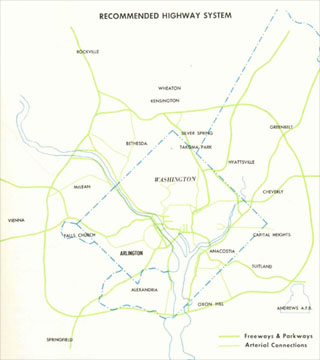
"I think the first thing that struck me was the social inequality of ramming a huge freeway through a largely black section of the city which would have just ripped up neighborhood after neighborhood, community after community. It was just a massive attempt to destroy half of Washington DC. Better connected whites in Northwest simply said no way are you going to ram a freeway down Wisconsin or Connecticut Ave or anywhere else in Northwest. So the highway department went back and redrew it and said "wow, we can go through Northeast, they don't have any clout." But the idea that this was going to be imposed on the city without any real opportunity to be heard from was to me an outrage...

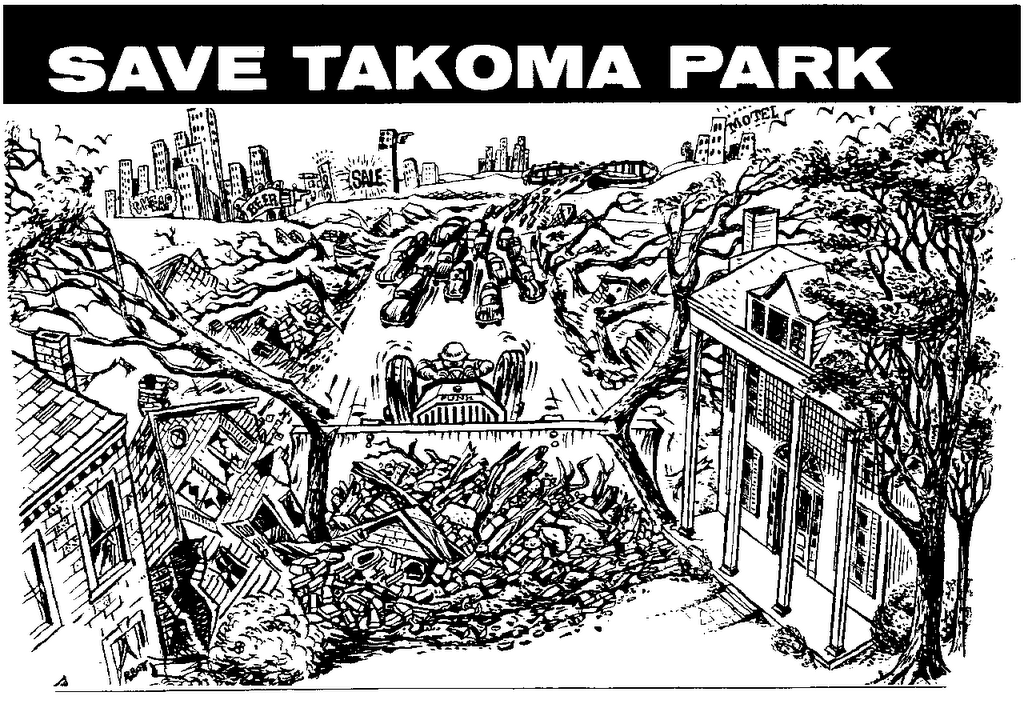
I quickly learned that there was no one to lead us or protect us. I heard that there was to be a hearing in Takoma Park, another community that the freeway would decimate. So, I took myself out and I watched what happened at the public hearing.. As I heard the testimony, I found the people that I wanted to work with. We started this huge network. We did not have the advantage of getting funding for anything, ever.
It began with meetings every week, meetings every day sometimes. We went to all the hearings and learned the tactics of the labor unions, by which I mean simultaneously organizing and educating, though without having the guns right in our faces. At the top of the list was educating. We realized that our job was to teach people what their rights were, to realize that the constitution guaranteed those rights, to stand up for them, and to speak out.

We were scrupulously careful in never having a meeting from which anyone was barred or never having a plan that was not within our constitutional rights to carry out, to hold a meeting, to picket, to demonstrate. Everything that we did was within the law. Still, what came down was the heavy, heavy boot of the FBI and our newspaper (the Washington Post). The Post called us everything from communists to pinkos to "that little band of discontented people..." Our job was to educate from the highest economic level to the lowest economic level and bring them all together at the same table whenever possible so that everybody was focused on the same issue. We were immensely advantaged by having a guy named Sam Abbott who was at heart and soul a great union organizer to focus and understand what was really going on. We understood that almost all of our troubles came out of the '56 Highway Act which created an enormous lobby of asphalt and cement people, auto companies, tire makers, all the people who make money from highways. They were well-entrenched in Congress and drinking deeply from the federal trough that was set up called the Highway Trust Fund. They had little respect for anyone who got in their way and they were astonished that anybody like me, a white woman living in a largely black neighborhood would get up and testify strongly, mincing no words...

The Federal Highway Administration, was in fact breaking its own laws left and right. They would not hold the proper hearings, they would not publish advance notice of meetings. We had to force the government to obey its own laws and regulations. The more you saw of how criminally they behaved, the more you learned the importance of learning what they were up to all the time. You tracked the organizations that supported the highways, that greased the wheels. You also learned another important thing: Always know where the money is coming from and where it is going. We eventually succeeded in networking a large area that included the suburban areas of Maryland and Virginia and the whole of the District of Columbia. The idea was to create a political climate of understanding of what was being done so that the lawsuits that were brought and the lawyers who had joined us-there were not many but there were some brilliant ones-would be judged in a political climate that understood the social injustice and the terror that was being visited upon this city and the suburbs...De Toqueville said that the most important thing for a democracy to succeed is an educated and involved citizenry. That does not mean learning how to be a rocket scientists. I'm talking about the operations of our government in action. You need to understand why people vote the way they do and what they're interested in.. You've got to help people to see how to look at things and analyze the political situation in a generalized way, not just go along because this Democratic guy is nice or that Republican says something you want to hear. You divorce the issue from party politics, stick with the issue and learn how it plays out in the big picture as well as in your own community...

Our first rallying cry was: "No White Men's Roads Through Black Men's Homes!"  We had to do that as offensive as it was to some people because it was absolutely the truth. It was indeed Black men's homes and businesses that were being confiscated. It was a very personal kind of insult, especially in a city where many blacks worked for the Federal government the city, to find out that your home could be gone just like that. The highway proponents felt no compunction about this. I don't remember whether it was the highway lobby men or the representatives from the FHA but they would say, "yeah, we built that road and we didn't even have to give them the moving money. They didn't know they were supposed to get it...

Our other rallying cry was: "Freeways No!, Metro Yes!" That was in everything we put out to focus hard on the fact that we needed good public transportation. If they built I-95, the inner loop, the outer beltways and all the other roads, there was no hope for a Metro being built because there would be no money. So we fought long, long and hard for years to break open the trust fund for other kinds of transportation. People had no idea that they had an option...Even in the 1960's, we were calling loud and clear for a multi-modal, interdependent, complete transportation system. We discovered that there was no "transportation plan" for the United States at all. That was a euphemism they used to use: "Oh, we have to build that road, it's a part of the transportation plan.". We were very happy when we learned, after being blackmailed as a city and told we would get no federal payment if we did not take the money for the freeways, that the money had been shifted over to Metro. I truly believe that the money was shifted because the freeway people realized that they were operating in a city that made it impossible for anybody to be elected unless they were against the freeways-including Barry. At the same time, they suddenly realized that if they got Metro, and built it in their image, they could make just as much money, maybe even more because then they could enrich all those suburban developers. We did lobby for good Metro stops in the city that would not destroy the whole neighborhood with uncontrolled development around every Metro stop. Developers did not get their way around every Metro station in the District-not yet at least. But they pretty much got their way at suburban Metro stations. Look at Tyson's Corner, for example. With Metro, they have simply recreated, by and large, highway-like development pattern. If we had had our druthers, we would not have built Metro out into the cow pastures, and we would not have built so damn deep. It was, is, an overbuilt system. I mean, look at Dupont Circle. I doubt very much that they had to go that deep. It is not a well conceived system. It was never integrated properly with the buses or light rail. Further, public transportation should be available to everyone and it should be free. There is no reason it can't be.

There were always agent provocateurs that we needed to deal with. We expected them to be at mass meetings. We learned to look at the shoes to see if they were shined. We learned not to be deceived by anyone who wore fake dashikis-there were lots of those. We learned to study the people who brought unnamed camera crews. We knew our phones were tapped, all the time. We received a lot of phone calls from so-called innocent people just asking how many people did you expect to turn out, or offering to provide coffee and donuts. They would also say that they were writing books and wanted to know if we thought this country was really worth saving. We knew people who worked at the FBI and they saw our files. Sometimes, provocateurs would go to our meetings and attempt to rouse the crowd to some kind of action that would force the police to interfere. That was never our style. It was always brought on by an individual or group of people sent there to try to force the crowd into some kind of useless action.. I used to get called up by white people who thought they were looking after my good and they would ask me, "why do you associate with those people? They don't even use good grammar?" They would also say that they thought the company I kept was dangerous because they thought some of them were what they used to call "pinkos." It was very silly. I would say "why don't you stop worrying about the style of their speech and listen to the content..." Ten years later, we won a lawsuit against the FBI for harassment

We learned that it was important to distinguish the private decision making process from the public one. The private decision making process in Washington consisted of the Gold Plan, the Silver Plan and the Blue Plan. The Gold Plan was for those who will make serious money from the private decision making process. The Silver Plan was for the hangers on who receive secondary benefits from the Gold Plan. The Blue Plan is the one that the community is supposed to see...Generally speaking, you never get a look at the Gold Plan unless you paid thousands of dollars a year to belong to 'the club...'

"The media has taken over the job of the highway lobby of brainwashing the American people. We are so deep into the culture of the automobile now that we have no notion how we have been suckered into it. Children from the time they are born assume the right of the automobile. It is the biggest sex symbol in America. But our dependency on the car has backfired all over the country: air pollution is worse, traffic jams are far worse then they ever were, water runoff is worse.

Despite all this, the highway lobby continues fighting for more roads...Recently, the Post was a part of a transportation study (now reading from a recent Post editorial): "The study was conducted by a group of national and regional transportation specialists hired by the Board of Trade with funds from various member companies...including this newspaper." This study was a done deal before it was completed so it would say exactly what they wanted it to say; and what they want is to build roads that we prevented them from building in the 60's..."

I think one of the most important lessons that came out of our efforts is that there is no compromise unless there are equal advantages on both sides. Otherwise it's not compromise. What are activist giving up when the compromise? Nothing. What are the highway people getting? Everything they wanted. It's really important to understand this because people are always being asked to be reasonable. There is no such thing as being reasonable when somebody is putting your head on a chopping block. People are deceived all the time: "Let's get a few of you together and talk it over, we're all reasonable people." You are dead in the water if you buy that. Never go in small groups. Take everybody. Let everybody hear what the highway proponents are up to."
Such sentiment was what was largely precipitated by the sort of 'planning' that had fashioned Washington, D.C.'s planned main northern traffic artery into something that became highly unpopular, from what had previously been a relatively uncontroversial idea when initially proposed via the John F. Kennedy administration in November 1962.
http://wwwtripwithinthebeltway.blogspot.com/2012/01/crafted-controversy-scuttling-of-jfks-b.html
Rooney is the latest to die among those involved with Washington, D.C.'s freeway planning controversies.

Reginald Booker Dead
http://wwwtripwithinthebeltway.blogspot.com/2016/04/reginald-h-booker-dies-last-year-at-74.html

Marion Barry Dead
http://wwwtripwithinthebeltway.blogspot.com/2014/12/marion-barry-dies-and-obituaries-dont.html

Peter S. Craig Dead:
http://wwwtripwithinthebeltway.blogspot.com/2009/12/peter-s-craig-rip.html

Ruth Abbott Dies
http://wwwtripwithinthebeltway.blogspot.com/2009/10/ruth-abbott-widow-of-sammie-abbott-dies.html 


Saturday, April 30, 2016

Reginald H. Booker Dies Last Year At 74

Booker was an Emergency Committee on the Transportation Crisis (ECTC) figure who worked with Sammie Abbott and Marion Barry


REGINALD HARVEY BOOKER (74) Passed peacefully on July 19, 2015. He is survived by one daughter, Jaha Booker; two sons, Daniel Gayden and Jamal Booker; three grandchildren, four sisters, Germerish Booker, Arlene Jackson, Ruby Holt and Wendetta Watson; two brothers, Harry Jackson, Jr. and Jerome Jackson; and a host of other relatives and friends. Services will be Monday, July 27 at Horton's Chapel, 600 Kennedy St., NW.; 10 a.m. viewing and 11 a.m. service -

http://www.legacy.com/obituaries/washingtonpost/obituary.aspx


I wrote about this freeway controversy previously:

http://wwwtripwithinthebeltway.blogspot.com/2009/10/ruth-abbott-widow-of-sammie-abbott-dies.html

http://wwwtripwithinthebeltway.blogspot.com/2014/09/getting-over.html

http://wwwtripwithinthebeltway.blogspot.com/2012/01/crafted-controversy-scuttling-of-jfks-b.html

A Takoma Park, Maryland resident's 1967 Letter to then Gov. Spiro Agnew How This Controversy Was Being Stoked:

http://wwwtripwithinthebeltway.blogspot.com/2015/02/june-1-1967-duncan-wall-letter-to-spiro.html

Sunday, December 07, 2014

Richard Layman Proposes Renaming 11th Street Bridges After Marion Barry


http://urbanplacesandspaces.blogspot.com/2014/12/marion-barry-ceremonial-vs-real-name.html
I don't favor a renaming of a major arterial for Marion Barry, although I'd be fine with a ceremonial renaming of a bridge--many states including Maryland names bridges in honor of politicians, soldiers killed in the line of duty, etc.

For such a name change, I'd nominate the 11th Street bridges--which connect the city, east and west of the Anacostia River, and Ward 6 to Ward 8--as suitable for renaming in honor of Marion Barry.

I concur.

I agree. Given his role with ECTC, in stopping I-95 by Catholic University of America, he played a role in disproportionately routing the freeway traffic through DC's least affluent areas.


Thursday, December 04, 2014

Marion Barry Dies and the Obituaries Don't Mention His Anti Freeway Role!


Marion Barry dies.  March 6, 1936-November 23, 2014.


Numerous obituaries, such as the following from The Washington Post- and none mention his role in stopping Washington, D.C.'s freeway system!
http://www.washingtonpost.com/local/obituaries/marion-barry-dies-4-term-dc-mayor-the-most-powerful-local-politician-of-his-generation/2014/11/23/331ad222-c5da-11df-94e1-c5afa35a9e59_story.htm
D.C. debut
In 1965, Mr. Barry arrived in Washington to direct activities for the SNCC. This came at a critical juncture in D.C. race relations.

Nationally, the civil rights movement was heating up. There had been riots in the black enclaves of several urban centers, and more were to come. In Washington, the post-World War II flight of whites to the suburbs had given the city a population that was majority African American. But the local government was dominated by whites and subject to the oversight of white-dominated congressional committees. There was no home rule.

The stage was set for Mr. Barry’s D.C. political debut. Clad in a dashiki shirt and speaking in inflammatory rhetoric, he established himself as a visible presence with a forceful voice that could not easily be ignored.
In January 1966, he led a one-day bus “mancott” to protest a fare increase requested by D.C. Transit. He organized a “Free D.C. Movement” to press for home rule. He called D.C. police “an occupation army.” In 1969, he tore up a parking ticket, struck the officer who had placed it on his windshield and was charged with assault. The case ended with a hung jury.
Rep. John L. McMillan (D-S.C.), the chairman of the House Committee on the District of Columbia and one of the most influential men in Washington, was among the targets of his rhetoric. “The citizens of the District of Columbia,” Mr. Barry declared, “are tired of living on the McMillan plantation.”

In the winter of 1967, Mr. Barry resigned as director of SNCC’s Washington office, declaring, “Now we must concentrate on control — economic and political power.”
With financial support from the U.S. Department of Labor, he organized and directed a group known as Pride Inc., which put more than 1,000 inner-city youths to work clearing alleys of trash and debris, killing rats — and later running gas stations and a landscaping business and managing an apartment building.

In 1971, Mr. Barry won his first election for citywide office, defeating the chairman of the school board, Anita F. Allen, for an at-large seat on the board.

None of the obituaries or even his wikipedia bio mention his involvement with the doctrinaire anti-freeway group ECTC.

http://wwwtripwithinthebeltway.blogspot.com/2007/11/ectc-1970.html

ECTC  EMERGENCY COMMITTEE ON THE TRANSPORTATION CRISIS
CHAIRMAN: R.H. Booker  VICE CHAIRMEN Marion Barry, Jr. - Charles I. Cassell  Fed Heutte - Johnie D. Wilson  SECRETARIAL COMMITTEE: Mary Alice Brown, Chairman- Ann Heutte - Angela Rooney - LEGAL COUNSEL Simon L. Cain TREASURER: Mrs. Leon Brooks PLANNING CONSULTANTS: 2MJQ  Black Advocacy Planners  SPEAKERS BUREAU: Louis M. Florenzo, Chairman  PUBLICITY DIRECTOR: Sammie Abdullah Abbott

It is as if that movement is not being seen as part of a legitimate protest, but rather a manipulation.

Indeed.  The anti freeway protests had some legitimate targeting- such as the earlier planning as the I-66 new swath displacing 100s of residences along Florida Avenue and U Streets, and the 1964 recommended route for the North Central Freeway that seriously deviated from the recently assassinated John F. Kennedy's vision for a B&O Route North Central Freeway.

But was we know, the freeway should have been (and can still be built) properly, such as with the I-66 North Leg; and that the doctrinaire anti freeway stance was effectively a protest on behalf of the wealthiest and most political powerful to get over upon the general public.
http://wwwtripwithinthebeltway.blogspot.com/2014/09/getting-over.html

Thursday, October 22, 2009

ECTC Paid To Riot Via Covington & Burling?

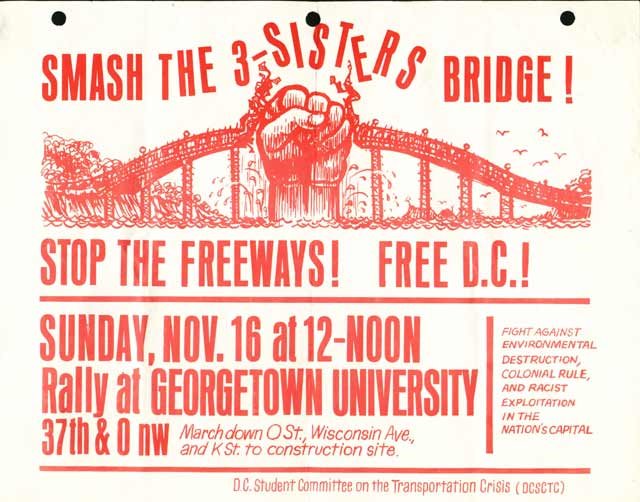
Paid Anti-Freeway group to Riot to disrupt public hearings on I-266 Bridge poised at Georgetown University

According to Gilbert Hahn Jr.: The Notebook of an Amateur Politician (and how he began the D.C. subway)


http://books.google.com/books?id=6mZWVFsxFg8C&pg=PA4&lpg=PA4&dq=Reginald+Booker+freeway&source=bl&ots=KVpr2SHlgH&sig=5TWeeQ27IZPFP0gy3Hnu6p2lbjI&hl=en&ei=JZbfStC_NIrIlAehvOBK&sa=X&oi=book_result&ct=result&resnum=5&ved=0CBoQ6AEwBA#v=onepage&q=Reginald%20Booker%20freeway&f=false

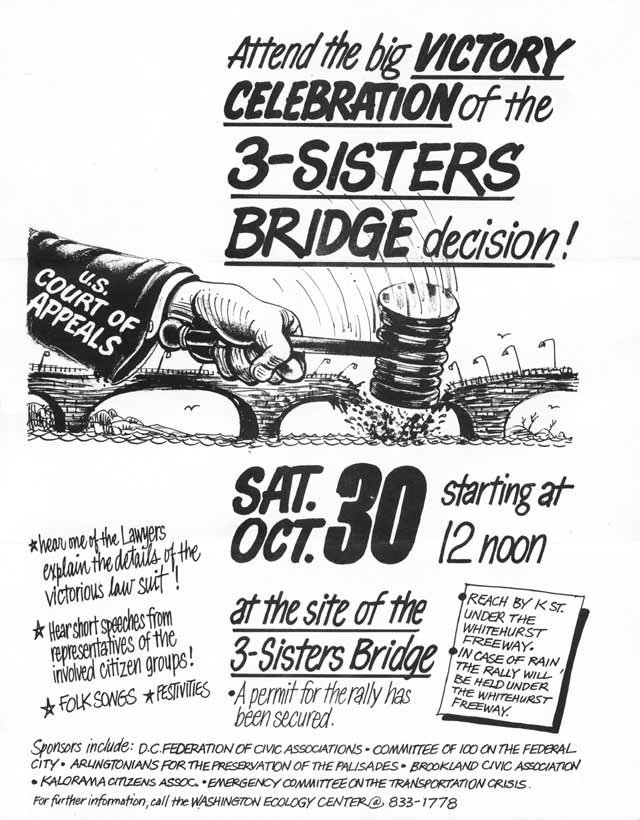
“…Arrayed against the freeway lobby was a fiercely vocal, but not very impressive group called the Emergency Committee on the Transportation Crisis. This was a group headed by an otherwise very nice young man named Reginald Booker and included Sammy Abbott, former Communist candidate for the House of Representatives from Buffalo and later the mayor of Takoma Park. It also included Julius Hobson and, as one of the chorus, Marion Barry. I held some freeway and Three Sisters Bridge hearings, which immediately broke up into several famous riots (but more of that latter.)

The committee [ECTC] was funded by solid citizens of Georgetown, like attorney Ed Burling. Their interest in the matter was to prevent the Three Sisters Bridge – or any highway – through Georgetown, and so they funded Reginald Booker and all of his conferees very lavishly. When a hearing on the Three Sisters Bridge broke up yet in another riot, I had Ed Burling and his fellow Georgetowners to thank for paying Booker and Company to riot. Among other things, I was hit with a flying ashtray.

Why was I so adamant? I don’t give myself any particular merit badges for agreeing with the argument that freeways would ruin the city and Balkanize its different parts by putting up a “Chinese Wall” through the middle of a neighborhood. It’s just that I thought that it was a good thing not to have the freeways and the Three Sisters Bridge, and a better thing if I could manage to get the subway system funded instead.
This curiously ignores the concept of urban freeways below ground in tunnels, versus say that of surface and elevated RR berms that quad sect Washington, D.C.


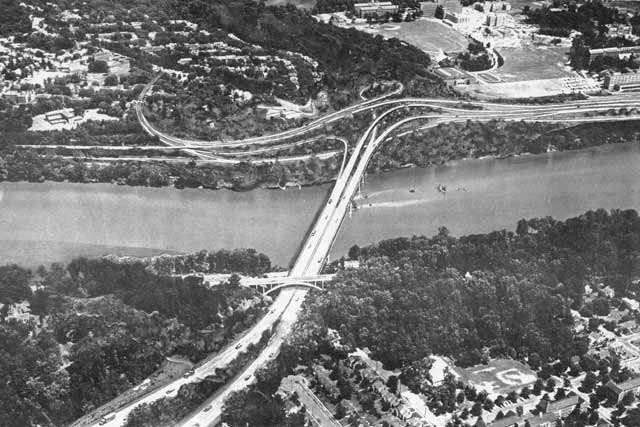
The proposed I-266 'Three Sisters Bridge'
pointing at Georgetown University

Perhaps this curious RR-freeway double standard has something to do with this significant backer being a RR industry attorney?

Edward B. Burling (1877 - 1966)

The name "Burling" within the name of the law firm Covington & Burling refers to its co-founder, Edward B. Burling. According to the firm's web site:

"Judge J. Harry Covington and Edward B. Burling opened the doors of Covington & Burling in Washington, DC, on January 1, 1919. "

http://www.cov.com/washington/

"The founders of Covington & Burling LLP foresaw the pervasive effects of the forthcoming era of federal legislation, regulation, and taxation. In 1919, they sought to create a firm in the nation's capital that could advise and represent corporations located anywhere in the nation or the world on a wide range of legal issues. Today our Washington office has over 300 lawyers representing clients according to the highest standards and fulfilling the firm's strong commitment to public service."
Edward Burling, who would die in 1966, had a son, Edward Burling Jr. According to his 2002 obituary:
(excerpt)

http://www.nytimes.com/2002/12/03/us/edward-burling-jr-94-senior-partner-at-a-top-law-firm.html

Edward Burling Jr. was born in Chicago on Feb. 5, 1908. His wife, Frida Frazer Winslow, said he was not given a middle name, but was called junior to avoid confusion with his father.

He graduated from Milton Academy in 1925, Yale University in 1929 and Harvard Law School in 1932. He then volunteered to work for the presidential administration of Franklin D. Roosevelt. Thomas G. Corcoran, a presidential aide and later a powerful Washington lawyer, assigned him to work for the legal staff of the Reconstruction Finance Corporation, a New Deal agency. He next worked on the staff of the Treasury Department.

In 1935, he joined the law firm that his father had founded with Mr. Covington, and, except for his war service, in the Army Air Force in World War II, stayed there until his retirement at 65.

Two of his principal clients were the metal-cutting tool industry and the National Trust for Historic Preservation. He acted as financial adviser to corporate clients and represented their interests before regulatory agencies, particularly the Federal Power Commission, now the Federal Energy Regulatory Commission.

Mr. Burling was known for extensive philanthropy, and among the recipients were child adoption agencies in Washington.

The law firm Covington & Burling has long been allied with the private organization, the "Committee of 100 on the Federal City", which along with U.S. National Capital Planning Commission, was founded by Frederic Adrian Delano, uncle to 32nd U.S. President Franklin Delano Roosevelt, and brother in law to Burling via marriage to a pair of sisters.

1201 Pennsylvania Avenue
since 1981
the Covington & Burling building

Covington & Burling's other co-founder, former U.S. Congressman James Harry Covington, was a law professor at Georgetown University.


James Harry Covington (1870 - 1942)

James Harry Covington (August 15, 1863 – May 14, 1939) was an American jurist and politician. He represented the Maryland's 1st congressional district in the United States House of Representatives from 1909 to 1914, and served as chief justice of the Supreme Court of the District of Columbia from 1914 to 1918.

Covington was born in Easton, Maryland, and attended the Maryland Military Academy at Oxford. He entered the law department of the University of Pennsylvania at Philadelphia in 1891, attending at the same time special lectures in history, literature, and economics, and graduated in 1894.

Soon thereafter, Covington began to practice of law in Easton. He was an unsuccessful Democratic nominee for the Maryland State Senate in 1901, and served as State’s attorney for Talbot County, Maryland, from 1903 to 1908. He was elected as a Democrat to Congress in 1908 and served the 1st Congressional district of Maryland from March 4, 1909 until his resignation on September 30, 1914, to accept the position of chief justice of the Supreme Court of the District of Columbia.

Covington served as chief justice of that court from October 1, 1914, to June 1, 1918, when he resigned to practice law in Washington, D.C.. He was a professor of law at Georgetown University from 1914 to 1919, and was appointed by President Woodrow Wilson as a member of the United States Railroad Commission in January 1918. He and Edward B. Burling established the law firm of Covington & Burling on January 1, 1919. Covington died in Washington, D.C., and is interred in Spring Hill Cemetery of Easton.

Covington served as Worthy Grand Master on the Supreme Executive Committee of the Kappa Sigma Fraternity from 1892–1894.

http://en.wikipedia.org/wiki/J._Harry_Covington


Kappa Sigma Official Site

Kappa Sigmas are taught to live their lives by the Star and Crescent, which are the symbols of the Fraternity that make up the official badge:

The Star and Crescent shall not be worn by every man, but only by him who is worthy to wear it. He must be a gentleman... a man of honor and courage... a man of zeal, yet humble... an intelligent man...a man of truth... one who tempers action with wisdom and, above all else, one who walks in the light of God.[9]

The Star and Crescent is also used as part of the guidlines behind Kappa Sigma's strict no-tolerance anti-hazing policy. The Fraternity takes all allegations of hazing very seriously and routinely pulls charters from guilty chapters which can be as old as 130 years.

They also follow the four cornerstones of the Fraternity: Fellowship, Leadership, Scholarship, and Service.

http://en.wikipedia.org/wiki/Kappa_Sigma


Frederic A. Delano's 'Family'

ECTC's Creation Assisted By Roman Catholic Church Assett John D. Kelly

ECTC’s creation assisted by John D. Kelly – graduate of Jesuit Canisius College in New York, civilian employee in intelligence for the Army Security Agency for 26 years, retiring in 1974, who in 1983 was ordained a deacon and hence served at St. Anthoney’s Roman Catholic Church in Brookland, D.C.

http://www.washingtonpost.com/wp-dyn/articles/A25814-2004May13.html

(excerpt)

Earlier, when local and federal agencies made plans to run an expressway through Brookland, Mr. Kelly joined Sam Abbott, Thomas and Angela Rooney and others in forming the Emergency Committee on the Transportation Crisis, said his son Peter T. Kelly of Aspen, Colo. The committee "held protests at the Three Sisters Bridge site, at various blocks around our neighborhood which the government had seized by eminent domain, and at congressional hearings and city council meetings," his son said.

It was "ultimately successful in having the planned I-95 expansion canceled and the Metro rail system built." John Kelly was quoted in a 1978 Washington Post article about residents of Brookland who fought the plans for the North Central Freeway and advocated the Brookland-Catholic University Metro station. "Our answer has been yes to urban transit, no to highway," Mr. Kelly said. "The subway is a welcome addition to the community. We're not interested in high-density development here. We're concerned about preserving and refining the quality of life that exists."

In the 1960s, Mr. Kelly also was active in the strike against the D.C. Transit System, the precursor company to Metro that was privately owned by businessman O. Roy Chalk. "I can remember the 'Erase Chalk' posters around the house and my dad driving around D.C. in our station wagon giving free rides to people who were participating in the strike," his son said.

John Kelly was born in Medicine Hat, Alberta, Canada, and grew up in Batavia, N.Y. He served in the Army during the Korean War. He received a bachelor's degree from Canisius College in New York and did graduate work in literature at Catholic University. He moved to Washington in 1948 and settled in Brookland. After a close friend died of cancer in the late 1970s, Mr. Kelly became interested in the hospice care concept that was growing in the Washington area. He began a program with hospice-type volunteers at Providence Hospital in Northeast Washington.

In 1980, he began studying for the Permanent Diaconate Program of the Catholic Archdiocese of Washington. He was ordained a deacon in 1983 and served at St. Anthony's Catholic Church in Brookland.

ECTC Creations

A Collection of ECTC Materials the "Emergency Committee on the Transportation Crisis"
"The action coordinating committee of organizations fighting against freeways and for rapid mass transit"

June 26, 1968

April 11, 1969

July 15, 1969

February 17, 1970 April 30, 1971 Letter to Senator Kennedy


October 2, 1969


Monday, October 19, 2009

Ruth Abbott - Widow of Sammie Abbott -- Dies

Was married to Sammie Abbott- artist and 1930s labor organizer who later became Mayor of Takoma Park after serving as perhaps the central figure of the local grass roots activism against the 1960s era freeway planning

Ruth Abbott
at the Franklin Street area overlook of the Metropolitan Branch RR
looking towards the U.S. Capitol Building
on un-built D.C. I-95 tour, 1997
(I-95 was not planned to run along this western side of the RR- which to the north runs directly alongside Catholic University of America,
instead being routed through residences to its east)

http://www.legacy.com/WashingtonPost/DeathNotices.asp?Page=Notice&PersonID=134546701

Ruth G. Abbott


ABBOTT RUTH GRACE ABBOTT Of Takoma Park, MD died October 14, 2009 at age 89. She was married to Mayor Sam Abbott, with whom she had three children: physician Abraham Abbott (wife Sonata); artist Susan Abbott Arisman (husband James); and writer Nancy Abbott Young. She is also survived by grandchildren: Jim Abbott, wife Alyson, daughter Ashley; Roxanna Abbott Lewis, husband Eric, son Maxwell; Nathaniel Vaughan; and Colin Arisman. Services will be held by the family. In lieu of flowers, donations may be sent in Ruth''s memory to the Public Citizen Health Research Group, c/o Dr. Sydney Wolfe, 1600 20th St., N.W., DC 20009.


Ruth Abbott at the I-95 stub
(since paved over with parking)
on un-built D.C. I-95 tour, 1997

Ruth Abbott at Barney Circle Underpass
on local highway tour 1997

SE Freeway Truncation


Glen Harper,
who favors building the ICC highway via environmentally advanced road design,
with Ruth Abbott 1998
on Glen Harper's ICC Tour

Sammie Abbott poster, November 1964


Sammie Abbott art

Looking down Cedar towards
the junction with Birch

The Abbotts were spurred to oppose the North Central Freeway - the north-south route for I-95 and I-70S in northern Washington, D.C. with the public unveiling of 'Route #11' - "Railroad-Sligo East" with its destructive and out of the way route deviation through some of the oldest areas of historic Takoma Park, Maryland,
inexplicitly disregarding the John F Kennedy Administration November 1962 proposal for a North Central Freeway strictly hugging the existing B&O [Metropolitan Branch] RR

According to Ruth, the woman who lived in that house, depicted to the right in his rendering, in 1964 had refused to sign their petition against the North Central Freeway

In 1964 the Abbotts lived on Birch,
at the very spot marked in the above 1964 report illustration with the number "320".

Afterwards, they resided on Holly
at the spot where the 1964 plan placed the northbound on and off ramps

1964 Option #11 I-70S segment leaves RR in Silver Spring


1964 Option #11 I-70S segment cuts through Takoma Park,
on longer route
through 471 houses, including the Abbott's

1964 Option #11 I-70S segment at New Hampshire Avenue


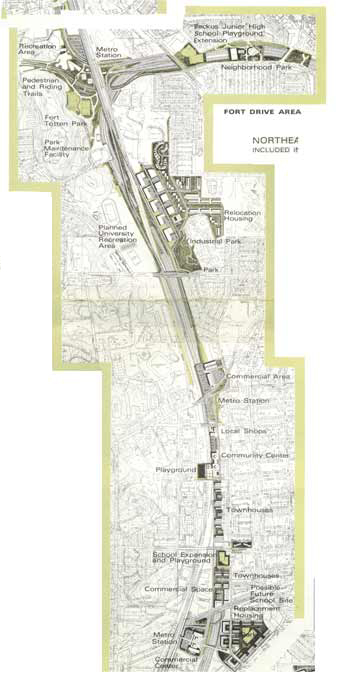
Under this 1964 plan, the North Central Freeway intercepted an I-95 Northeastern Freeway at Fort Totten
that was routed in D.C via the Fort Drive Route -- Fort Circle Park -- between Gallatin and Galloway Streets, and in Maryland via North West Branch Park


Further south, the 1964 plan's I-95 segment ran fully east of the RR's parallel industrial belt, displacing over 200 dwellings
in the Turkey Thicket neighborhood
between Taylor Street and Michigan Avenue NE,
and
69 south of Monroe Street and west of 10th Streets NE, plus
the historic 1837 vintage Brooks Mansion


1963-1964 Study
37 route options


JFK 1962 Plan-
freeways and rail transit

This plan proposed that the North Central Freeway tightly hug the existing railroad to reduce its local impacts, yet was entirely disregarded -- without explanation -- by the 1963-64 North Central Freeway study with its 37 routes all over the NE map inflaming local opposition. It was not until late 1966 that a supplementary report was released that followed the 1962 plan.

1966 Supplementary Study
B&O Route North Central Freeway
(officials waffled on this, refusing to commit
to this far less impactive 1966 plan

while continuing consideration of the 1964 plan
as late as 1968!)


1966 B&O North Central Freeway I-70S segment in Silver Spring, Maryland
with cut and cover tunnels alongside Montgomery Community College


1966 B&O Route North Central Freeway
I-70S segment
3 lanes hugging each side of the RR


1966 B&O Route North Central Freeway
I-70S segment
at New Hampshire Avenue


1966 B&O Route North Central Freeway,
retains I-95 interception at Fort Totten (with added jog of route westwards further into Fort Totten Park), with Fort Drive-Northwest Branch Park Route
for I-95 connection to the stubs at the Capital Beltway


1966- Proposed 'air rights' cover,
I-95 segment
alongside Catholic University of America-
disappears from subsequent 1971 version;

1966 B&O Route North Central Freeway instead employs industrial zone along RR's east side,
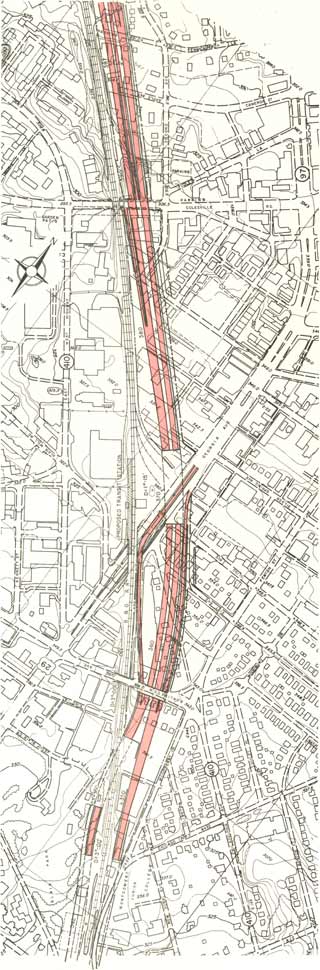
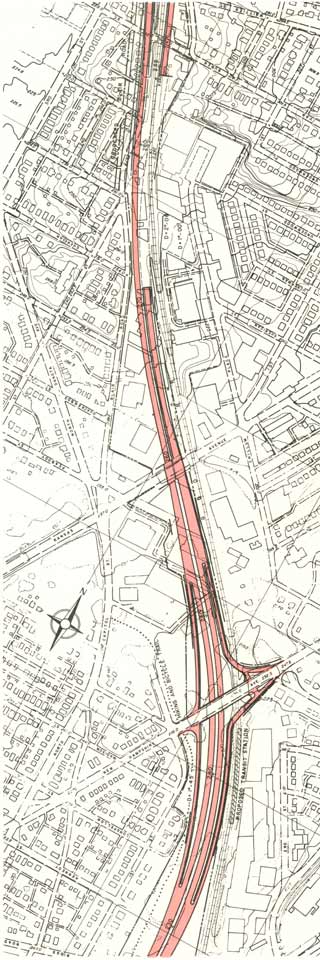
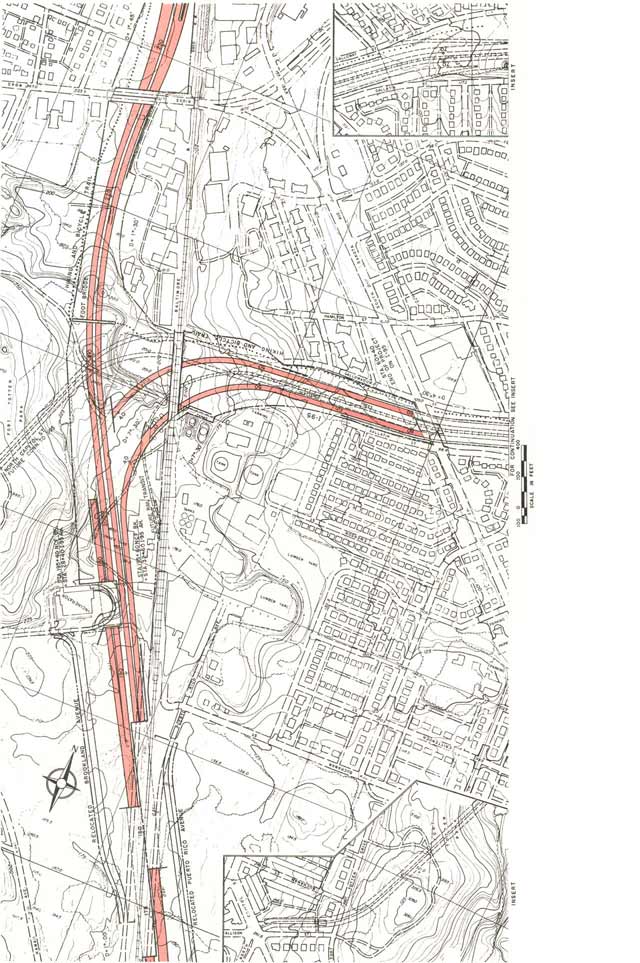
entirely sparing Turkey Thickett and Brooks Mansion, limiting local residential displacement to the 69 south of Monroe and west of 10th Street. By 1970, the plan is further refined (either by running even closer to the RR or via substituting a sloped embankment with a vertical retaining wall) to reduce this number from 69 to 34, with the 1971 proposal showing this highway in a cut and cover tunnel from a few hundred feet north of Michigan Avenue, to just south of Rhode Island Avenue, with replacement housing atop.


The proposed I-266 'Three Sisters Bridge'
pointing at Georgetown University

Notably, it was this area of Brookland near Catholic University of America -- the 69 houses reduced to 34 by the 1970 revision, along with the Three Sisters Bridge next to Georgetown University -- that apparently received the ECTC's greatest protest activity during the late 196s-early 1970s, as opposed to the 600+ targeted by un-built D.C. I-95's southernmost segment -- the North Leg East that would connect to the existing Center Leg (3rd Street Tunnel) at New York Avenue and 4th Street.

1971 B&O Route North Central Freeway,
I-95 segment
Washington, D.C. Brookland - CUA area

1971- retains the I-95 Northeastern Freeway Fort Drive-Northwest Park route

1971- alternative of I-95 Northeastern Freeway via New Hampshire Avenue-PEPCO Route- see 1973 Maryland report
connecting through the field of the Order of the Eastern Star home


'The Freeway Fighter's Primer' ECTC June 1971


'An Open Letter to Every Member of the U.S. Senate and House of Representatives'
Reginald H. Booker, ECTC, June 23, 1968


1970 ECTC poster-
shows 1966-71 North Central Freeway with the 1955- version of the Inner Loop
with the cross-town I-66 North Leg via an open trench along Florida Avenue and U Street NW eastwards to New Jersey Avenue past which it transitions as a raised berm. Though dated 1970, the poster does NOT show the I-66 K Street Tunnel alternative proposed by U.S. National Capital Planning Commission's Elizabeth Rowe in 1965, and then already the official preference of Federal and D.C. officials -- with the D.C.Department of Public Works being the holdout -- and included as an east-west alternative to the SE/SW Freeway, even after the deletion of the north-south North Central/Northeast Freeway

anti-freeway ECTC poster (excerpt)
dated January 1970,
with Sammie Abbott as publicity director
and, as one of its Chairmen- Marion Barry,
who later became D.C. Mayor, and
in 1996 advanced the 1st official proposal since the 1970s
for
extending I-395 via a new tunnel design

Ruth attended the 1998 D.C. Historical Society panel Freeways in Washington- see a review.

1998 D.C. Historical Society panel Freeways in Washington
Keith Melder, (author "City of Magnificent Intentions"), moderator, with
Angela Rooney, Douglas Willinger and Jeremy Korr


Angela Rooney, Douglas Willinger, and Jeremy Korr


audience with Ruth Abbott (center)