Showing posts with label Peter S. Craig. Show all posts

Saturday, February 27, 2016

Jimmy Carter 1976- World To Run Out of Petro in 35 Years


This was the general type of mindset that was used to 'de-map' the Washington, D.C. Freeway system during the 1970s, as displayed in this November 13, 1973 letter by Peter S. Craig on behalf of the "Committee of 100 on The Federal City" to D.C. Mayor Walter E. Washington, regarding the proposed I-695 South Leg Freeway to connect I-66 with the SW Freeway:
http://wwwtripwithinthebeltway.blogspot.com/2009/04/doctrinaire-anti-new-highways-position.html
. ... This request is made because, from my review of the “Combined Corridor and Design Report”, it is obvious that Mr. Airis is proceeding from demonstrably erroneous or obsolete premises, errors that would be manifest if there were an adequate hearing. For example, his report proceeds from the assumption that there will be a 50 percent increase in area population by 1990 with a 100 percent increase in auto travel. Such an assumption is incredible in the face of (1) recent actions by EPA under the Clean Air looking toward the necessity of reducing future auto travel and (2) the growing fuel crisis which, according to Administration spokesmen, will lead to gas rationing within six months and, by 1990, may well render the private automobile as obsolete as the horse and buggy. Furthermore, it should be noted that the proposed six-lane South Leg is designed on the premise that at least 50 percent of the traffic utilizing it would come from two highly controversial (and unapproved) freeways- the [I-66] North Leg Freeway and the [I-266] Three Sisters Bridge."
 (2) the growing fuel crisis which, according to Administration spokesmen, will lead to gas rationing within six months and, by 1990, may well render the private automobile as obsolete as the horse and buggy.

Never-mind the feasibility of alternative fuels, synthetic fuels, alcohol based fuels based upon various forms of bio-mass.   Somehow we were simply going to abandon automobiles in mass rather than admit to the reality that the market would simply shift to alternative liquid fuels.  Or that we could not even consider an Open Fuel Standard, as per the sort of technology seen with the 1963 Chrysler Turbine.  Let alone bring about the mass development and deployment of quite excellent electric and hybrid electric automobiles.

And never-mind even the utter inaccuracy of such predictions, as we are now 25+ years past 1990, and petroleum supplies have become sufficient as to bring about a major drop in petroleum prices, which after spiking to over $100 an barrel are now down to around $30.

Nor the potentially misleading Peter S. Craig characterization about the proposed South Leg's accompanying "highly controversial" freeways, the North Leg and the Three Sisters Bridge.   Though the latter was quite well protested, the North Leg had become far far less controversial before 1973, as per the plans approved by the D.C. City Council, U.S. National Capital Planning Commission (NCPC) and the D.C. Department of Public Works by the late 1960s, replacing the initial highly unpopular version of the North Leg seen in the 1955 Inner Loop report for an extensive new swath along Florida Avenue and U Street, with the alternative promoted by that initial plan's opponents as Elizabeth Rowe of NCPC and the Committee of 100 on the Federal City, of a cross town I-66  Tunnel under K Street NW.


1971 Inner Loop

Nor the characterizations (see underlined) contained within a May 12, 1975 letter by Elizabeth Rowe upon behalf of the Committee of 100 On the Federal City:
Dear Mr. Chairman and Members of the Council:
The Committee of 100 on the Federal City respectively requests early action by the Council on two very pressing transportation matters:  
First the de mapping of unnecessary and unwanted freeways in the District of Columbia through amendment of the city's Comprehensive Plan and appropriate requests to the US Department of Transportation for the removal of such freeways from the Interstate system
Second, the initiation by the Council, in cooperation with the Mayor, of a request to the U.S. Department of Transportation for the transfer of the federal aid formerly earmarked for such freeways (in excess of $1.4 billion) for completion of the presently-authorized Metro rail transit system.
These actions are necessary to implement two very pressing needs: First to remove forever the cloud of destruction and more autos in an auto-chocked city caused by the presence of obsolete freeway plans in the comprehensive plan and on the interstate system; and second, to help meet the escalating costs of construction of the Metro system.
Respectfully submitted,
Mrs. Elizabeth Rowe, Chairman
That letter was accompanied by a letter dated the same day from Peter S. Craig calling for the deletion of every freeway segment that ended up being 'de-mapped', including that of the I-66 K Street Tunnel, upon the grounds that "...This Council already has urged that Virginia abandon I-66 inside the Beltway in Virginia. Consistent with this action, I-66, within the city should also be scrapped."  never-mind that I-66 inside the Beltway was built and opened to traffic by 1982.  See both of these May 12, 1975 letters here.

Notably, the U.S. Federal Highway Administration documents about these 1975-1978 "de-mappings" strangely, show a map of the proposed freeway system, not as approved by U.S. NCPC and the D.C. City Council, such as the 1966 "Low Level" B&O Route North Central Freeway that was close to what the JFK Administration prescribed in 1962, but rather an earlier set of plans featuring the latter (1963+) version of the East Leg to RFK Stadium/East Capitol Street, and the 1967 straight line diagonal tunnel route version of the South Leg, but with the earlier plans for the North Leg, together with the infamous 1964 bastardization of the B&O North Central Freeway, as if the controversy was being stoked within the Federal level.


Rather than address such a strange set of discrepancies though, by asking if and why the U.S. Federal Highway Authority had actually kept these earlier highly unpopular routes as its official plans into the 1970s, the Peter S. Craig letters instead focusing upon simply "de-mapping" the entire yet to be built system, asides from the short extension of the Center Leg north from Massachusetts Avenue to K Street, as a source of obtaining some extra funding for the WMATA system.  Never-mind that the 1962 JFK Administration planning had included both what essentially became the WMATA system and the freeways.

Apparently, at no time, did any of this discussion of any of these "de-mappings" ever ask if they were truly necessary, nor contrast this extra funding for WMATA with the extra costs for reviving any of these freeways at some time in the future, as the purported permanent nature of of such "de-mappings" - as opposed to say simply deferring them -- would translate to a failure to preserve rights of ways/easements from subsequent real estate development situated without regards to their impacts upon such costs.   Consequently, we have seen such real estate development travesties as the blockage of the path of the Center Leg Tunnel northbound on-ramp just to the north of K Street by the irresponsibly located "Golden Rule" apartment building; the current "Capitol Crossing" air rights project that steals half of Center Leg's 8 lane design capacity, various projects irresponsibly built too close to the B&O corridor constricting its expansion, plus that of "The Hampshires" townhouse project upon what was traditionally the open field of the Masonic Eastern Star Home property along the north side of New Hampshire Avenue directly in the path to connect the B&O and PEPCO corridors- with both these latter two projects initially promoted as products of the Jarvis Company.

It would be one thing if planning as that simply involved the highly locally destructive earlier planned routes.

For instance, I don't consider the Takoma Towers apartment building in Takoma Park, Maryland, built in 1972 and located exactly upon the infamous 1964 route deviation, to be a "demolition special" as that's an insane routing location for the North Central Freeway.  Nor would I apply such a term to say something built upon the path of the original North Leg along Florida Avenue and U Street.

Rather, I use that term to describe such projects as:

- Those that intrude upon the Center Leg, as "Golden Rule"The intruding portions of the substructure of "Capitol Crossing".

- Projects in Brookland, D.C. as those directly upon the B&O Route as planned in 1962 and 1966+.  Such as that upon the I-95 portion, as those to the east as a portion of the recent development just south of Rhode Island Avenue, and to the north with the the Douglass Development project to the east at 805-809 Channing Place NE, "Brookland Station" project along 9th Street, whatever is proposed upon the WMATA facility, and the industrial strip further north.  Plus the nearest portion of what was recently built at Fort Totten.  And those to the west upon what is the better idea for routing the southbound lanes -- consider the vista just south of Franklin Street! -- as the "Arts Space" duet, anything along the eastern side of 8th Street, and further south, the MRP proposal to the west, plus something upon the Brookland WMATA facility.

- Those further north along the B&O, whether from the 1960s as the Montgomery Gardens apartments immediately west of the B&O just north of its entry into Washington, D.C., thus pushing both directions of the I-70S (I-270?) North Central Freeway to the east to bring it into conflict with the row of older houses along Takoma Avenue, and currently, with what WMATA is having EYA build upon their facility in Takoma.   And especially that area's projects as "Cedar Crossing" and "Elevation 314" which constrict the B&O corridor in an exceptionally irresponsible manner as potential death traps located within the footprint of a potential de-railment sending heavy freight train cars tumbling downward from a railway that is elevated into these dangerously close wood framed residential buildings.  Past de-railments, one from this elevated railway in 1976, and another from a non elevated segment more than a mile northward in Silver Spring Maryland in 1996 would avoid such potential death, as the former tumbled into Blair Road and the latter into a parking lot, with the respective houses and apartment building being set further away from the railroad.  

- And of course "The Hampshires" townhouse project directly in the path to connect the B&O and PEPCO corridors- the latter being infinitely preferable than the earlier routing via Northwest Branch Park, and the logical option under Federal legislation barring the use of park-lands for highways when there is a reasonable alternative, as in this case, of a 250 foot wide electrical power line right of way- with the combined B&O-PEPCO Route and its connection along the northern side of New Hampshire Avenue constituting the Least Environmentally Damaging Practicable Alternative (LEDPA) for a northern radial highway for Washington, D.C.  Despite this, U.S. National Capital Planning Commission (NCPC) Executive Director Patricia E. Gallagher, AICP, in a decision regarding a proposed re-zoning:
http://wwwtripwithinthebeltway.blogspot.com/2011/02/us-ncpc-perjury-2006.html
On behalf of the West Group Development Company, LLC and The Jarvis Company, LLC, the District of Columbia Zoning Commission has referred a proposed action for a consolidated Planned Unit Development (PUD) and a map amendment for a residential development for review and comment. The proposed PUD (6000 New Hampshire Avenue, NE is located within the Lamond-Riggs neighborhood in northeast Washington, D.C. on approximately 11.5 acres in Parcel 126/74 and Lot 858 in Square 3719, bounded by Rittenhouse Street, New Hampshire Avenue, Peabody Street, Chillum Place and Sligo Mill Road, NE, and in Lots 69–73, 801, 824 and 826 in Square 3714, bounded by Peabody Street, New Hampshire Avenue and 1st Street, NE. ... [upon] ... the former campus of the Masonic Star Nursing Home and Med-Star Health offices and is currently an open lawn area that is under-developed....
Pursuant to delegations of authority adopted by the Commission on August 6, 1999, I find that the proposed consolidated Planned Unit Development (PUD) and related map amendment for a residential development (6000 New Hampshire Avenue, NE) located in Parcel 126/74 and Lot 858 in Square 3719 bounded by Rittenhouse Street, New Hampshire Avenue, Peabody Street, Chillum Place and Sligo Mill Road, NE and in Lots 69 – 73, 801, 824 and 826 in Square 3714 bounded by Peabody Street, New Hampshire Avenue and 1st Street, NE, Washington, D.C., would not adversely affect any federal interests nor be inconsistent with the Comprehensive Plan for the National Capital.
Such projects most certainly adversely affect the federal interest of an efficient, modern highway system for the Nation's Capital, in particular to provide a mixed use radial freeway within the vast northern Washington, D.C. arc served by no freeways whats-over between the George Washington Parkway in Virginia and the Baltimore-Washington Parkway from Maryland, no interstate freeways from I-66 to the west in Virginia to I-295 from the south in Maryland, and mixed use freeways from I-395 (former I-95) in Virginia to Route 50 from Maryland, as inside the Beltway Virginia I-66 is not open to trucks.

This U.S. NCPC "planning", like that of the 1975+ de-mappings, make no such apparent mention of any of this, nor that the Baltimore-Washington Parkway and the Route 50 Freeway feed into a sole freeway into Washington, D.C.- the antiquated DC 295 Anacostia Freeway, which is both substandard for traffic serviceability and for local connectivity being a conventional surface and elevated facility severing D.C.'s neighborhoods to the east - incidentally its least affluent area - from the Anacostia River waterfront.

All of these projects intrude upon space needed remedying this deplorable status quo, conflicting with vital links to the north necessary as alternative routes as the vital B&O-PEPCO North Central/Northeastern Freeway constructed in a neighborhood friendly fashion as cut and cover tunnelways beneath new linear parks atop to spread the traffic burden, as well as permit closing the existing antiquated-divisive Anacostia Freeway to facilitate its replacement with a modern cut and cover facility to re-unite D.C.'s least affluent neighborhoods with the Anacostia River waterfront. 
 
The outright "de-Mapping" rather than deferring the freeways, for fiscal and environmental-social justice reasons, should have been defined as criminal.

Sunday, March 28, 2010

Eisenhower's Burning Tree Commute Desire?

An Eisenhower favorite hang out, immediately within the I-495 Capital Beltway


Recently a controversy emerged amongst historical researchers of Washington, D.C.’s truncated freeway system. It is centered upon claims that Dwight Eisenhower opposed urban freeways; these are based upon a story of his encountering freeway constructing in either in the NW area of Washington D.C. (which did not exist, e.g. the West Leg by the Kennedy Center started construction in 1961 or later) or just to the north of the construction of the circumferential Capital Beltway (which was under construction, though not an urban freeway). See the conversation thread here.

Perhaps seeing a portion of the Capital Beltway under construction through the Bethesda area inspired Eisenhower to think about these road’s right of way requirements- a thought making me ask if he ever questioned the use of eminent domain particularly as being used at the time of his Presidency in SW Washington, D.C. which leveled far more buildings then did the right of way for the SW Freeway which started construction by 1959.

The Eisenhower library papers cited indicate that he had misgivings about urban freeway planning, specifically that through the “congested parts of the city”, calling for a subsequent study: a fact pattern of the extensive freeway system of the 1959 ‘Mass Transportation Plan’ displacing the dwellings of some 33,000 people that fits with the subsequent U.S. Presidential Administration of John F. Kennedy’s November 1, 1962 report for a smaller though still continuous freeway system with I-66 and I-70S into, and I-95 through the District with far less negative local impacts.


However, what primary resources indicate that Eisenhower opposed urban freeways unequivocally? Deleting urban segments from the early stages of the construction of the national interstate highway system does not necessarily translate to never having urban segments, particularly as definitions of terms as ‘urban’ or ‘congested’ and conceptualizations of feasibility may vary, as can those of routing and design for reducing impacts?

Would Eisenhower agree, in the case of the Washington, D.C. area, of having I-95, I-66 and I-270 never extend within the Capital Beltway, nor favor today’s status quo of the past few decades of I-95, I-66 and the SE Freeway’s truncations?

The following suggests not.

Concerning the recent conversation about Eisenhower’s position on urban freeways, here’s what I just located, page 2 of a letter by Peter S. Craig (Gelman Library Special Collections)

The big question is who ‘in the White House’ is responsible for this pressure.

One member of the Executive Committee of the Northwest Committee for the transportation Planning reports that he heard the President himself wants the Wisconsin Avenue corridor because he was irritated by the traffic congestion in getting to Burning Tree Country Club.

All White House contacts should be pursued in an effort to pin down the source of pressure on Welling, Tallamy and others to push through the Wisconsin Avenue corridor routing.

A google search of ‘Burning Tree Country Club’ led me to this in Maryland, just outside NW Washington, D.C., and immediately inside the Capital Beltway segment between the western I-270 spur and the Potomac River.

It is something that comes up frequently in searches about Eisenhower, as he evidently spent a great deal of time there, as an avid golf enthusiast said to have played some 800 games throughout his 8 years as U.S. President, alongside many powerful people. Just 'google' the terms 'Dwight D. Eisenhower' with 'Burning Tree Country Club'.


Constructing the Wisconsin Avenue corridor segment of the NW Freeway, as planned in 1957 southwards from the Pooks Hill interchange of the eastern spur of today’s I-270 and the Capital Beltway – miles to just south of a set of cut and cover tunnel underpasses beneath Tenley Circle, would have displaced 74 houses within D.C., and an indeterminate number in Bethesda, Maryland, largely within the footprint of the WMATA induced re-development that leveled much of that downtown.

Responding to barriers further south of denser, older Georgetown, and the political ban upon routing via the Glover Archbold Park (with only a brief cir 1957 consideration of a ‘Cathedral Heights Tunnel’- details unknown to me other then it running somewhere near the National Cathedral), official planning by 1958-59 went with planning the NW Freeway’s southern segment as the ‘Cross Park Freeway’. This would swing due east from the Wisconsin Avenue corridor just before Fannie Mae, skirting the northern edge of the Sidwell Friends School-Cleveland Park area, crossing below Connecticut Avenue and across Rock Creek Park to the Mt Pleasant area along Fort Adams Road and Irving Place before turning south some 500 west parallel to 14th Street, meeting the east-west I-66 North Leg of the Inner Loop between T and U Streets.


Almost all of this plan’s building displacement would be to Rock Creek Park’s east, in Mt Pleasant. Yet all of the 1959 revisions re-specifying certain segments as tunnels would be to the west, with the depressed Fannie Mae-Sidwell Friends and Cleveland Park-Connecticut Avenue segments respectively as drilled and cut and cover tunnels, though to east, only considering the options of sloped embankments versus retaining walls, despite the denser development resulting in greater displacement and greater local separation by the addition of the uncovered freeway.


The opposition from to the west was instrumental in stopping the Cross Park Freeway planning (and indeed any freeway within NW D.C. west of 16th Street NW: the eastern edge of Rock Creek Park), namely that of Peter S. Craig, Cleveland Park resident, and railroad industry with the Washington, D.C. law firm Covington & Burling (co-founded in 1919 by railroad industry attorney Edward Burling), along with the ‘Committee of 100 on the Federal City’ (founded in 1924 upon the popular excitement about constructing the McMillian Plan’s West Mall-Lincoln Memorial, by Burling’s brother in law, Frederic Adrian Delano who sat on the original US Federal Reserve in 1914, and was uncle to 32nd U.S. President Franklin Delano Roosevelt).


Stopping the NW D.C. Freeway planning stopped any further design evolution – something conceivably advance able with the idea of a subsequent look at a deep drilled tunnel in the Cathedrial Heights general area and/or parallel to Glover-Archbold Park that would be significantly longer then that to skirt Sidwell Friends, though providing a significantly shorter direct route.

That would not necessarily stop freeway planning, with a faction from Bethesda pushing the idea of constructing the 1959 Mass Transportation system’s North Central Freeway along Georgia Avenue- an idea with far greater impacts then the 1959 NW – Cross Park Freeway.

Meanwhile another faction or factions favoring I-70S uphill parallel (via the former trolley right of way) to the Canal Road corridor- seemingly a more direct route from the White House to this Burning Tree Country Club.

Clearly there is far more to this story to discover.

Tuesday, December 29, 2009

Peter S. Craig: An Editorial Reply

The Washington Post Does Not Get It-
subverting transportation based upon lies
(excerpts)

http://www.washingtonpost.com/wp-dyn/content/article/2009/12/20/AR2009122002242.html

For more than two decades, Mr. Craig battled business interests, developers and members of Congress who wanted to build a bridge over the Potomac River to carry Interstate 66 into Georgetown and seven multilane highways, which would have destroyed more than 200,000 housing units, many in historically black sections of the city.

http://www.washingtonpost.com/wp-dyn/content/article/2009/12/22/AR2009122203176.html?sub=AR

CHRISTOPHER WREN, the great 17th-century English architect, whose many works dominated the London scene, had as his epitaph, "If you seek his memorial, look about you." Similar words might be fitting for Peter S. Craig, who died Nov. 26 at the age of 81, only in his case it would be what you didn't see that would mark his significance. ... [such as] a long-planned North-Central Freeway running through much of the eastern part of the city and over places where thousands of people live. In all, Mr. Craig and his allies succeeded in blocking about three-quarters of the interstate highway system once planned for the District....

There are still some who argue that the city made a major mistake when it blocked those highways. Most Washingtonians, we think, when they look about the city, with all its beauty and its history as community and national capital, would say otherwise.
The Washington Post reports he was a railroad attorney at Covington & Burling- something to think about concerning Washington, D.C.'s beauty, given the Posts' own expressed cluelessness convenient for diverting attention from the blight of to Washington, D.C. NE in the areas behind Union Station, with beauty in from, but ugliness behind.

http://www.washingtonpost.com/wp-dyn/content/article/2009/12/20/AR2009122002242.html

Mr. Craig was working for the powerful Covington and Burling law firm in the 1950s, specializing in transportation regulation matters, when he became aware of plans to build a freeway from the Georgetown waterfront up Glover-Archbold Park and out Wisconsin Avenue into Bethesda, where it would have joined what is now Interstate 270.

Craig was also long involved with the “Committee of 100 on the federal City”- a private organization founded in 1923 by Frederic A. Delano, uncle to FDR and brother in law to Covington & Burling co-founder, railroad industry attorney Edward Burling. OK, so this law firm has a long history representing the railroad industry.

He got involved in 1959 when planning was going to bring a highwa, the I-70S Northwest Freeway, near his residence in Cleveland Park.

Why- the logic of the Wisconsin Avenue corridor as the most commercialized corridor spaced roughly midway between the Potomac River and the B&O corridor, & the barring of a highway allowing trucks via Glover-Archbold Park, leading to a search of alternatives, with a brief consideration of a Cathedral Heights Tunnel, before a 1958-59 route via a split at the top of Glover-Archbold for a parkway not allowing trucks, with an I-70S continuation via a separate route known as the Cross Park Freeway starting as a tunnel just north of Fannie Mae and the northern edge of the Sidwell Friends School property to parallel Tilden Street, skirting the northern edge of Cleveland Park and entering another tunnel crossing east of Connecticut Avenue and emerging to cross Rock Creek Park via a highway arc bridge before continuing as an open depressed freeway through Mt Pleasant, starting at , crossing 16th Street before turning south to parallel 14th Street continuing to an interchange with the open trench I-66 along U Street.

This highway would have displaced 74 dwellings along the Wisconsin Avenue corridor, about 8 to the east in or near Cleveland Park, and 100s if not 1000s to the east of Rock Creek Park. Whereas the 1959 version added the two tunnel segments in the Sidwell Friends/Cleveland Park area in addition to the Tenley Circle underpass, it would fail to even consider tunnel segments anywhere to the east of Rock Creek Park, limiting any options to merely depressed with sloped embankments or depressed with vertical retaining walls. From a preservationist standpoint, the most sensible opposition was that to the east of Rock Creek Park, with the least sensible being Bethesda, Maryland which ended up tearing out and replacing most of its downtown business district anyway via WMATA Red Line subway induced denser development that could and should have included an underground highway.

Its effective cancellation via the 1960 – Act mandating a moratorium on free planning for DC NW west of Rock Creek Park – via political pressure from the area with the fewest impacts testifies to the dominance of political affluence.

This did not mean that Peter S. Craig necessarily opposed other freeways within Washington, D.C.

During the early 1960s, Craig and the "Committee of 100" publically supported the concept of a “Y” route B&O railroad I-70S North Central Freeway featured by the November 1, 1962 Kennedy Administration White House report "Recommendations for Transportation in the National Capital Region; A Report to the President for transmittal to Congress by the National Capital Transportation Agency". Regarding that multi-model concept, the report stated:
http://wwwtripwithinthebeltway.blogspot.com/2006/12/1962-national-capital-transportation.html

"avoiding the substantial relocation of persons, loss of taxable property and disruption of neighborhoods that would result from constrction of the Northeast, North Central and Northwest Freeways proposed in the 1959 plan. Further savings are realized by placing the rapid transit lines to Silver Spring and Queen's Chapel in this same railroad corridor."
The B&O corridor makes perfect sense not only as a railroad corridor providing a band of lightly developed industrial property, but also with its placement roughly midway between the Potomac River and the eastern portion of the I-495 Capital Beltway in Maryland.

It was consistent with a philosophy embodied in proposals made via Craig cir. 1962. Not for not buildings the highways. But rather for building highways instead more via existing corridors/right of ways, occasionally coupled with the idea of some short segments of these highways as tunnel.

I found two such proposals in perusing some of his papers and those of the Committee of 100 on the Federal City that are graciously made publicly available at the GW University Gelman Library Special Collections: constructing inside the Beltway Virginia I-66, not via the official route, but rather via a reconstructed fully grade separated Route 50 (already a major 4 – 6 lane artery generally flanked by service roads); and constructing the downtown D.C. north-south I-95 Center Leg (known today as the I-395 3rd Street Tunnel), not via the official routing via a swath cut via clearing a swath of buildings between 2nd and 3rd Streets, but instead as a pair of cut and cover tunnels respectively beneath 2nd and 3rd Streets. Obviously, neither idea was adopted, and I did not find any evidence of any official consideration.

Craig at times expressed favor for this concept for the Georgetown waterfront via removing and replacing the elevated Whitehurst Freeway with a tunnel within the existing right of way; in 1968 the Committee of 100 briefly proposed extending that tunnel beneath the Potomac – a Three Sisters Tunnel – to Virginia; they soon abandoned that idea due to the costs of drilling a sufficiently long tunnel to accommodate a sufficiently gentle grade transition for trucks, with Craig’s idea for a shorter tunnel only along the Georgetown waterfront being coupled with the idea of it being sufficiently reduced in capacity not to preserve anything but rather so that it would be useful to fewer.

Such was followed by Elizabeth Rowe with the I-66 K Street Tunnel proposal

The flip- said to have been guilted by Abbott. Since he strictly opposed freeways in NW, he would have to do the same elsewhere.

Its absurdity- was in response to a response to a bastardized program - came in the name of stopping white mans roads through black mans homes. The idea of opposing “white mans roads through black mans houses” could make sense: as such meant a road that would go through a less affluent area rather then a more affluent area, or through the latter without the extra mitigation of tunnels seen in more affluent areas. Such example of this include the 1955 Inner Loop design for I-66 different treatments west and east of New Jersey Avenue- to the west as trench, to the east as an elevated berm, the 1959 NW Freeway that Craig stopped which would have taken fewer then 100 from the Maryland line to Rock Creek Park, but considerably more to the east, with tunnels only for areas to the west, and of course the 1964 NCF report’s options. [This led to some intelligent things as the I-66 K Street Tunnel proposal via Elizabeth Rowe in 1965-66. ] But opposing such was hardly was synonymous as simply stopping freeways as that would simply kick the can elsewhere- a main consistency of the shifting polices of Craig and the Committee of 100.

He could have called for greater right of way efficiency and tunnelization for the highways within the western part of the inner loop.

He could also have done that with the NW Freeway proposing a different tunnel for its southern end. But AFAIK he did not.

He could have called for greater right of way efficiency and tunnelization for the highways within the eastern part of the east loop. Oddly to me, despite all of his opposition to say the Glover-Archibold Parkway I saw no indication he opposed the Northwest Branch Park routing for the I-95 Northeastern Freeway before he opposed the freeway outright, failing to apply the concept of reusing existing corridors in this instance with that giant PEPCO power line right of way to New Hampshire Avenue that would require only 13 retail strip properties, and clusters of 24 and 5 houses flanking a short jaunt through the open field of the Masonic and Eastern Star Retirement Home at 6000 New Hampshire Avenue NE to meet the B&O Route. Craig could have further applied such concepts to the B&O NCF. But AFAIK he did not.

Instead he took a course that would effectively be a “white mans road through black mans homes” – or area, depending upon if it displaced dwellings along the railroad corridor in Anacostia SE – via the Anacostia Freeway. If it had not displaced any homes, it would have simply been placing the traffic disproportionately through such areas by stopping both the NW Freeway and the NCF-NEF.

Craig's allies, the Committee of 100 did this with a 1968 proposal for re-routing inside the Beltway I-95 along a longer portion of the NWBP and Virginia 4 Mile Run.

It was SE and in Virginia that Craig's allied "Committee of 100" would soon promote receiving even more of the burden, with their work to cancel the B&O Route North Central Freeway, supplemented by their 1968 proposal for a longer routing of inside the Beltway I-95 via Northwest Branch Park bringing it directly to the Anacostia Freeway, with the Baltimore-Washington Parkway reconfigured to come directly into the I-295 East Leg of the Inner Loop, and with I-95 continuing via the Anacostia Freeway extended somehow across the Potomac River to Virginia and continue via the 4 Mile Run corridor to the existing I-95 Shirley Highway.

Illustration: 1968 proposal, Brookland houses, ECTC protests

All to avoid 69 post WW1 townhouses targeted by the 1966 plans at the western edge of Brookland from the west side of 10th Street NE to the railroad’s eastern side, all to the south of Monroe Street that crosses the railroad just to the south of Catholic University of America located immediately to the railroad’s west side along Brookland Avenue. These 69 dwellings, a fraction of that targeted by the 1964 and 1960 proposals which would have decimated Turkey Thicket and Brooks Mansion which the 1966 and later plans spared, were colorfully protested by ECTC- the Emergency Committee on the Transportation Crisis, even after this number of 69 was reduced to 34 by a 1970 D.C. Department of Public Works design modification realigning the freeway closer to the railroad, and/or substituting its eastern side sloped embankment with a vertical retaining wall. Internet writer Mark Bentley, in misc.transport.road noted:

http://wwwtripwithinthebeltway.blogspot.com/2007/02/review-of-1998-panel-freeways-in.html

Mr. Korr was followed by our own Douglas Willinger, who, in rather agonizing detail, laid out some of the literally dozens of alignments that were at one time or another planned for DC. The most horrifying was of course the Rock Creek Park alignment. By 1971, as we know, the alignment was almost entirely along mostly abandoned industrial corridors, and had gone from taking 4,500 homes to a whopping 69. But of course those 69 homes were worth saving, as they are today worth 1,017,391,304 each (225,000 commuters at $10/hr for 30 years spending an extra half hour on the beltway). The bargain of the century, in fact, in that you can buy one today (well, one that's remaining, several have been torn down anyway) for about $75,000. Not a bad return!

With only 34 rather the 69 that $1,017, 391, 304 figure is roughly doubled.

With only 11-14, that doubled figure is roughly tripled.

I did not find any discussion on how a longer route via a longer route along a more sensitive watershed area of Northwest Branch Park was necessarily more worthy then a more direct route via the existing railroad-industrial corridor, nor consideration of tunnel segments. Nor did I find anywhere near the amount of consideration that lead to the B&O NCF route concept in 1962, regarding whatever they gave to the Craig-Committee of 100 flip, against the B&O North Central Freeway by 1966 reportedly in response to Sam Abbott shaming him into eventually opposing any proposed freeway, never-mind the actual designs and consequences, all based upon the B&O North Central Freeway’s bastardization which lead to the rush of popular opposition.

Indeed, the idea of “white mans roads through black mans homes” a great deal of sense for a NCF that would displace 720/590 with options going as high as 2770/--- on the heels of cancelling a NWF that would have taken fewer then 100 dwellings to the west of Rock Creek Park, as opposed to simply the 1962 Kennedy Administration B&O Route NCF that as per the 1966 supplementary study would have displaced 372 within DC, of these 69 for the I-95 segment. That slogan made far less sense against the B&O concept due to its central location and status as an industrial corridor providing a swath of lightly developed properties.

Perhaps this was because such a mangling, such as that seen in 1964, was required to stoke the opposition, hence the political need to use the righteous opposition to the 1964 plan to inflame the passions against any NCF, and for purely selfish reasons.

Such appears to be the case, even after the release of the 1966 plan with officials waffling on the earlier plan through 1967 and as late as 1968. From a June 1, 1967 letter from Takoma Park, Maryland resident Duncan Wall:

The re-studied proposal also tacitly admitted that the route first proposed was needlessly, even carelessly if not ruthlessly, destructive of our communities. The new version hugged both sides of the existing Baltimore and Ohio railway, thus avoiding a new swath of destruction to divide our communities and sharply reducing the number of homes to be taken.

The reduced, re-routed proposal was made public last year with endorsement of D.C. And Maryland highway authorities. The D.C. Portion was forced through the National Capital Planning Commission by votes of representatives of the D.C. Highway Department and of the U.S. Bureau of Public Roads. From this we concluded, reasonably enough, that the highway authorities of the two jurisdiction cons (Maryland and D.C.) had reached a firm understanding with the Bureau of Public Roads.

Many of us were therefore astonished and aroused to preparations for renewed protests when Washington newspapers recently reported that the Bureau has acted to open it all up again. We have not found the Bureau forthcoming with candid information, but the press articles intimate an intention to force Maryland to accept modifications of route or design ostensibly "cheaper."

The result is that the whole controversy, which had been somewhat quiescent, is beginning to agitate the communities again. I can assure you this is so, for although I recently resigned chairmanship of the Metropolitan Citizens Council for Rapid Transit and write this simply as an individual citizen who wishes your administration well, I do remain in close touch with neighborhood sentiment on transportation-related issues.

As Governor of our State, you are in position better than we as private citizens to require straightforward answers from the Bureau of Public Roads.

You can also insure that the Maryland State Roads Commission refuses to go along with divisive proposals which these communities will regard as cause for new protests.
Such was sufficient time to stoke the opposition to get the DC City Council and the U.S. NCPC to flip their support to opposition.

Quote USNCPC 1968

Such fit with the pursued legal strategy, of declaring the freeway illegal for lacking support of the legally required government entities for approving additions and subtractions to the Washington, D.C. road network.- even as this was untrue as the Council voted to approve .--- and USNCPC had voted … supporting the NCF and East Leg – positions they would only change after much colorful protest by ECTC – the Emergency Committee on the Transportation Crisis disproportionately centered upon the 69 WW1 era houses in westernmost Brookland nearest to the B&O railroad this one portion of the I-95 NCF displacing houses – in comparison to the 600+ late 1800s houses as per the 1971 plans for its connecting segment to the built portion of the I-95 (now I-395) Center Leg (3rd Street Tunnel) that was also required for the Route 50/logical I-66 east extension, and which remained on planning books for about a decade after the B&O NCF’s abandonment.

Indeed it was the 69 – reduced by a 1970 DCDPW revision to 34 – where Brookland meets the B&O railroad immediately across from Catholic University of America, and at the site of the officially proposed I-266 Three Sisters Bridge practically pointing at Georgetown University that marked the two hot spots of latter 1960s-early 1970s anti-freeway protests. Such strategy by the anti-freeway forces would be matched by such ostensibly pro-freeway forces as the Federal City Council – founded in 1954 as a sort of rival to the Committee of 100 – which in 1966 issued a report on the DC freeway system with a sufficiently heavy emphasis upon opposing delays sufficient to have it endorse building the NCF via the 1964 plan - good for saving perhaps a few weeks on the construction and perhaps cheaper if eminent domain is sufficiently abused by underpaying for properties then the additional retaining walls and tunnel roof segments of something true to the 1962 Kennedy Administration NCF – at the expense of literally splitting the town of Takoma Park Maryland.

Such useful blundering for increasing popular opposition to freeways in general continued not only via the 1964 reports betrayal of the 1962 Kennedy B&O NCF, and the waffling and support for the 1964 plan at least as late as 1968, but with the addition of new design objections with each subsequent official proposal useful for generating new opposition. The 1966 plan, though following the basic 1962 concept, changes the arcs of the roadway connections to and from the I-95 Northeastern Freeway to increase the footprint within Fort Totten Park- an issue that saw being brought up in 1966 just prior to the release of the supplementary study in November 1966 as a new objection. The 1971 plan does this same basic thing with its reconfiguration of the I-70S segment alongside the northwest edge of Takoma Park; though changing it to a cut and cover tunnel through the Takoma Station area between Piney Branch Avenue and Aspen Street, a definite improvement from the 1966 plan’s tightly aligned elevated segment flanking the existing elevated railroad, the 1971 plan places all 6 lanes of I-70S along the railroad’s eastern side, bringing it into direct conflict to displace the northernmost along the railroad’s east within Washington, D.C. landmark Cady Lee Mansion- something I found no mention within the Peter S. Craig and Committee of 100 papers, though nonetheless certainly a potential flashpoint for generating opposition. Further helping sustain this opposition was the slowness of the DCDPW in adopting the K Street Tunnel alternative for I-66.

Such blundering would be the thesis of the antithesis of the openly opposing ever more doctrinaire anti freeway sentiment that under the guise of opposing “white mans roads through black mans homes” even opposed such things as an I-66 K Street Tunnel via some accompanying sentiment against people outside one’s immediate neighborhood – commuters – sufficiently parochial to have people forget how such an attitude would work against them anywhere they went out of their immediate neighborhood. …

In the middle were some people making an effort to serve the most by making design suggestions. The leader of the Shepard Heights[?] Neighborhood Association for instance questioned the need for a 3 sisters bridge while favoring new bridges connecting D.C.’s Eastern Avenue to SE and another to Virginia, and B&O I-95 which he proposed be redesigned to spare the 69 or 34 houses in Brookland via being elevated directly over the railroad, taking advantage of the area immediately to its west south of and by extension alongside CUA. The Urban Freeways Committee of the National Urban League would propose an alternative plan for the easternmost segment of the I-66 K Street Tunnel, by having it at Mt Vernon Square swing to beneath New York Avenue and continue to and east of the Center Leg (3rd Street Tunnel), this New York Avenue Tunnel intercepting I-95 as well. Yet their voices were eventually drowned out in a environment being dominated by theatrics and threats with ECTC reportedly being to riot by Covington & Burling at DC City Council meetings.

Council and NCPC votes 1969 1970

The NCF was 1st to disappear from official DC planning, though effectively remaining in that of MD until July 16, 1973.

Then I-266.

Then the I-66 K Street Tunnel

Then everything else but the Center Leg to New York Avenue and then the North Leg east tunnel to 1st street NE. then that, and then the leaving only Center Leg to New York Avenue, completed in 1986 with a set of added walls reducing its capacity in half- while not saving a single dwelling. IOW, a message of lets benefit fewer people for the benefit of fewer people.

Cancelled under the name of opposing “white mans roads through black mans homes”, the D.C. freeway system as planned by 1971 would have displaced a small fraction of the earlier designs: 148, 600+, 172 for completing the full Inner Loop, plus 59 for B&O/PEPCO I-95 and 303 for I-70S. Granted this could have been further improved significantly be redesigning the connecting segment along New York Avenue, as with my own redesign that reduces the displacement figure of 600+ residences along New York Avenue between New Jersey Avenue and North Capitol Street to as few as 34 all situated between New Jersey Avenue and 4th Street, south of N Street., via a gentler radii tunnel arcing beneath the intersection of New Jersey Avenue and N Street and ultimately connecting to the Grand Arc Mall Tunnel.

Such would be a far better memorial in honoring the positive side of Craig’s actions in preserving neighborhoods – although I have yet to see an ECTC or the “Committee of 100” mention or protest of the 600+ residences along New York Avenue between New Jersey Avenue and North Capitol Street, nor show any interest in extending Washington, D.C.’s monumental core beauty to the area to the relative ugliness of the area to north of Union Station- as I guess can be expected from the sort of doctrinaire anti-freeway, anti-questioning existing railroad design emanating from an attorney and a law firm well connected to the railroad industry, Covington & Burling.

Friday, December 25, 2009

The Washington Post Continues Lying About D.C. Freeways

From The Washington Post obituary of Peter S. Craig:
http://www.washingtonpost.com/wp-dyn/content/article/2009/12/20/AR2009122002242.html

For more than two decades, Mr. Craig battled business interests, developers and members of Congress who wanted to build a bridge over the Potomac River to carry Interstate 66 into Georgetown and seven multilane highways, which would have destroyed more than 200,000 housing units, many in historically black sections of the city.
This 200,000 dwellings figure is something the Post repeats from its error ridden November 2000 article, which was refuted in the newsnet group misc.transport.road, by participants including Scott M. Kozel, and in a Post forum since made unavailable. It is something that the Post has simply ignored any requests for them to publish a correction, and something they grossly misreported with that November 2000 article's map with the false depiction of the I-95 Northeastern Freeway route.

The Posts' characterization is misleading not only in the number, but in presenting it as static, when in fact the proposed freeways underwent significant routing and design revisions to reduce impacts via the greater use of existing right of ways and of tunnels for pollution containment and land reclaimation. It mentions for instance a North Central Freeway routed via a new swath paralleling the Georgia Avenue corridor, displacing some 4,000 dwellings- in fact the variant of this 1959 proposal appearing within the initial North Central Freeway engineering report in 1964 with the most residential displacement was option #4 "Sherman, 8th Street, Ritchie, Sligo" with figures of 2,770 within D.C., and 440 within Maryland.

But it fails to tell the readers that such a concept was explicitly rejected by the Kennedy Administration, which instead proposed for that highway a tight alignment along the B&O Metropolitan Branch Railroad, which is Washington, D.C.'s sole north-south transport and industrial corridor located roughly mid way between the Potomac River and the eastern north-south portion of the I-494 Capital Beltway.

It fails to mention the 1962 Kennedy initiative, and blurs the history by failing to go into the history of the design evolution of the B&O Route North Central Freeway- for instance not mentioning how the North Central Freeway was effectively sabotaged via the initial engineering report -- dated October 1964 -- disregarding the Kennedy administration idea of the North Central Freeway strictly hugging the B&O railroad together by this report excluding it while presenting an upwards of 37 preliminary and alternative routes[- see plates] mainly nowhere near the railroad, with a recommended route that deviated sharply from the railroad through Takoma Park, Maryland, taking 471 houses in 1 mile where strictly following the railroad would be a fraction of that, that followed the railroad elsewhere just enough to help derail the highway altogether. It fails to mention that it took another two years for the supplementary report to appear that essentially followed the Kennedy idea, yet which was continually sabotaged by officials refusing to commit to it, and such highway "advocacy" as that of the Federal City Council, which only weeks earlier issued a report calling for the North Central Freeway's construction via the earlier 1964 design simply to save some time and money. According to a letter to Maryland Governor Spiro T. Agnew from Takoma Park resident Duncan Wall dated June 1, 1967- excerpt:

The re-studied proposal also tacitly admitted that the route first proposed was needlessly, even carelessly if not ruthlessly, destructive of our communities. The new version hugged both sides of the existing Baltimore and Ohio railway, thus avoiding a new swath of destruction to divide our communities and sharply reducing the number of homes to be taken.

The reduced, re-routed proposal was made public last year with endorsement of D.C. And Maryland highway authorities. The D.C. Portion was forced through the National Capital Planning Commission by votes of representatives of the D.C. Highway Department and of the U.S. Bureau of Public Roads. From this we concluded, reasonably enough, that the highway authorities of the two jurisdiction cons (Maryland and D.C.) had reached a firm understanding with the Bureau of Public Roads.

Many of us were therefore astonished and aroused to preparations for renewed protests when Washington newspapers recently reported that the Bureau has acted to open it all up again. We have not found the Bureau forthcoming with candid information, but the press articles intimate an intention to force Maryland to accept modifications of route or design ostensibly "cheaper."

The result is that the whole controversy, which had been somewhat quiescent, is beginning to agitate the communities again. I can assure you this is so, for although I recently resigned chairmanship of the Metropolitan Citizens Council for Rapid Transit and write this simply as an individual citizen who wishes your administration well, I do remain in close touch with neighborhood sentiment on transportation-related issues.

As Governor of our State, you are in position better than we as private citizens to require straightforward answers from the Bureau of Public Roads.

You can also insure that the Maryland State Roads Commission refuses to go along with divisive proposals which these communities will regard as cause for new protests.

It furthermore fails to discuss the evolution of the I-95 Northeastern Freeway connection from the B&O Route to the I-95 'stumps' at the Beltway via the 195os decision to route it via the more sensitive closer watershed area of Northwest Branch Park in Maryland then that existing 250 foot wide right of way that conveniently parallels I-95 at and beyond the Beltway that would be ignored by official highway planning -- and apparently even the opposition -- until about 1971.

By so blurring the history, it increases the likelihood of confusion between say, 1,095, the figure for completing I-95 from the Maryland line to roughly along the B&O corridor though veering significantly into Brookland along 12th Street as per the 1960 proposal, with that of 1,166 for completing the entire system via the 1971 design, with figures of 148, 600+*, and 172 for the three areas along the downtown Inner Loop segment with displacement, and with a figure of 59 for completing I-95 from the Capital Beltway to just north of New York Avenue via the B&O-PEPCO combination. That figure of 59 includes the cluster of about 24 and about 5 along the northern side of New Hampshire Avenue flanking that large open field of the Masonic Eastern Star Home, just inside D.C., and the 34** at the western edge of Brookland. The I-70S portion of the B&O Route North Central Freeway as per the 1966 supplementary study would have displaced 303 dwellings [372 total NCF - 69 of I-95 segment] within D.C., and 163 *** in Maryland, a reduction from the figures of 720 and 590 for the infamous 1964 "recommended alternative" #11 "Railroad-Sligo East" proposal.

*the 600+ figure is reducible to as few as 34 via my superior alternative employing a some 1,400 radii transition cut and cover tunnel passing beneath the intersection of New Jersey Avenue and N Street, taking advantage of the convenient placement of the Dunbar HS building that seems to me as if it was situated for this very purpose, and transitioning to a multilevel tunnel beneath O Street to its junction with New York Avenue. This alternative entirely bypasses the stand of Victorian development extending from the southwest quadrant of New York Avenue and North Capital Street to New Jersey Avenue, minimally requiring displacement only within the area immediately west to the east side of 4th Street NW between N and M Streets, while sparing those prettier dwellings along M Street nearest to New Jersey Avenue, while providing a greater -- gentler -- tunneled turning transition radi then the 1971 design that had a 50 mph design speed.

**the 34 figure is reducible to about 11 if a portion of the highway is shifted to the railroad's immediate west side which has a generous amount of underutilized industrialized space. (However a development project just approved for this area includes a structure that is directly in the way -- IOW a 'demolition special' -- named the "Arts Walk". Meanwhile, further development along the railroad-industrial corridor promises to place 100s of new 'demolition special' dwellings, with official planning abandoning the idea of at least decking over a short stretch of the railroad.)

***the 163 figure is reducible qualitatively by a redesign that extends the idea of cut and cover tunnels that the 1966 supplementary study report shows alongside Montogomery Community College, further south beneath Takoma Avenue preserving the entire row of Victorian houses that face the railroad that both the 1966 and 1971 plans would have destroyed, along with preserving the sanctity of the landmark Cady Lee Mansion that the 1971 design displaced via replacing the 1966 plans configuration of 3 lanes in each direction flanking the railroad, with that instead placing both directions along the railroad's east side. (The 1966 plan's mainline would miss the houses to the north along Takoma Avenue but the open depressed design would push the replacement Takoma Avenue into the houses). However, the cir. 1966 construction of the Montgomery Gardens apartment complex -- located all the way up to the very edge of the RR's western side created a right of way chock at the expense of the Victorian structures that were built a century earlier with a sensible amount of set back allowing cut and cover highway tunnels.

Hence, if right of ways are preserved, and the designs are so further developed, completing I-95 through Washington, D.C. and all the way to the Capital Beltway in Maryland would displace as few as 74 dwellings- which was about the number that would have been taken for the D.C. Wisconsin Avenue corridor portion of the late 1950s NW Freeway.

Thursday, December 03, 2009

Peter S. Craig: RIP


Peter S. Craig, once an attorney at the Washington, D.C. law firm Covington & Burling and a member of the 'Committee of 100 on the Federal City' was an instrumental figure in preventing the construction of useful freeways within northern Washington, D.C., including a highly useful and environmentally responsive cross-town tunnel initially proposed by opponents of an earlier destructive alternative, resulting in a disproportionate amount of DC area traffic east of the Anacostia River
http://blog.eogn.com/eastmans_online_genealogy/2009/11/peter-s-craig-rip.html

Peter Craig passed away Thursday, November 26, 2009. He was both a Fellow of the American Society of Genealogists and a Fellow of The Genealogical Society of Pennsylvania. A brilliant genealogist, he was a friend to many, a prolific author on the Swedish Colonial Period in the Delaware Valley, and will be greatly missed.
According to The Washington Post
http://www.legacy.com/WashingtonPost/DeathNotices.asp?Page=LifeStory&PersonID=136594428

CRAIG PETER STEBBINS CRAIG, KNO, FASG (Age 81) Passed away peacefully after a brief illness on Thursday, November 26, 2009, surrounded by family in the Cleveland Park home he had lived in for more than 50 years. He is survived by his wife of 40 years, Sally; his children, Steve, Cary, Jenny and Katie; his brother John; four grandchildren; eight nephews and a niece; and countless friends. Memorial services will be held at 11 a.m., Saturday, December 19 at Gloria Dei Old Swede''s Church in Philadelphia, PA; and 4 p.m., Sunday, December 27 at the Friends Meeting of Washington. In lieu of flowers, contributions may be made to Community Council for the Homeless at Friendship Place ( www.cchfp.org ) or Crossings: Caring for Our Own at Death ( www.crossings.net ).
And from the Swedish Colonial Society
http://www.colonialswedes.org/Headlines/CraigPS.html

Dr. Peter S. Craig Receives Swedish Royal Honors


 Washington, D.C., 23 November 2002: Ambassador of Sweden Jan Eliasson (left) reveals the Badge of the Royal Order of the Polar Star to Dr. Peter S. Craig and Mrs. Sally Craig.

 Mrs. Kerstin Eliasson (left), Ambassador of Sweden Jan Eliasson, Dr. Peter S. Craig and Mrs. Sally Craig.

 Ambassador of Sweden Jan Eliasson (left) and Dr. Peter S. Craig, Knight First Class of the Royal Order of the Polar Star.


http://wwwtripwithinthebeltway.blogspot.com/2009/12/washington-post-continues-lying-about.html

Friday, April 24, 2009

The Doctrinaire Anti New Highways Position of the 1970s- Continued

Canceling highways because private automobile an obsolete concept by the 1990s...


-->
... This request is made because, from my review of the “Combined Corridor and Design Report”, it is obvious that Mr. Airis is proceeding from demonstrably erroneous or obsolete premises, errors that would be manifest if there were an adequate hearing. For example, his report proceeds from the assumption that there will be a 50 percent increase in area population by 1990 with a 100 percent increase in auto travel. Such an assumption is incredible in the face of (1) recent actions by EPA under the Clean Air looking toward the necessity of reducing future auto travel and (2) the growing fuel crisis which, according to Administration spokesmen, will lead to gas rationing within six months and, by 1990, may well render the private automobile as obsolete as the horse and buggy. Furthermore, it should be noted that the proposed six-lane South Leg is designed on the premise that at least 50 percent of the traffic utilizing it would come from two highly controversial (and unapproved) freeways- the [I-66] North Leg Freeway and the [I-266] Three Sisters Bridge."


The Doctrinaire Anti New Highways Position of the 1970s- Peter S. Craig

The Doctrinaire Anti New Highways Position- 'Green' Party

Sunday, December 28, 2008

Who Really Stopped Washington, D.C.'s Freeways

From Zachary Schrag
http://www.washingtonpost.com/wp-srv/liveonline/00/magazine/levey112700.htm

Washington, D.C.: I enjoyed the article, especially the profiles of Booker and Abbott. But let's not forget who really stopped Natcher's attempt to force the city to accept the freeways.

While the ECTC was gathering a few dozen people to march on picket lines and disrupt hearings, Congressman Robert Giaimo of Connecticut was gathering votes in the House of Representatives to release subway funds from Natcher's control. Thanks to his efforts, on Dec. 2, 1971, the full House voted 195 to 174 to release the D.C. share of Metro funds without forcing the city to build the Three Sisters Bridge. Following this defeat, a very rare case of the full House overruling an appropriations subcommittee chairman, Natcher never again seriously threatened Metro. And without that threat, the D.C. government had no reason to build the freeways.

Essentially there were three challenges to the freeways: in the streets by the ECTC, in the courts by Peter Craig (and his pro bono counsel, Roberts Owen), and in Congress by Robert Giaimo. Craig and Owen bought time, and Giaimo stopped Congress's blackmail. The ECTC, however noisy, did relatively little to change the minds of people in power. Radical protest can make a difference, but in this case the real victory was won by people working within the system.

Zachary Schrag
Columbia University


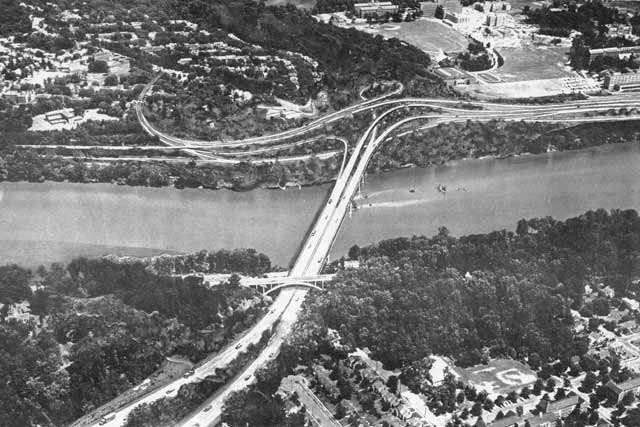
Proposed I-266 Three Sisters Bridge
looking from Virginia to Washington, D.C.
with Georgetown University at upper right.


... Peter Craig, a junior lawyer at the prestigious firm of Covington & Burling. Craig had come to Washington after graduating from Yale Law School in 1953.

In September 1966, following the N.C.P.C. vote, the Committee of 100 resolved to file a law lawsuit against the D.C. government and the N.C.P.C. to block [3 Sisters] bridge construction. Peter Craig, acting for the committee, turned to his former law firm, Covington & Burling. Partner Gerhard Gesell agreed to take the case for a nominal retainer and assigned lawyers Roberts Owen and Gerald Norton to the matter. Owen, the lead counsel, had paid little attention to the highway fight, but he enjoyed suing the government to force it to obey the law.

p 41 and 125 The Great Society Subway by Zachary M. Schrag


   Proposed I-95 B&O North Central Freeway next to Catholic University of America


Covington & Burling


Read About the Committee of 100's opposition to US NCPC's Extending the Legacy

Committee of 100 Ruminations


Frederic Delano 'Family' : U.S. NCPC, Committee of 100, and Covington & Burling


Subverting the North Central Freeway

Physical Realities Undermining the North Central Freeway

A Sampling Of Attitudes Towards D.C. I-95