Saturday, September 14, 2013

COUNTER REFORMATION- An Introduction

Prerequisite Readings:

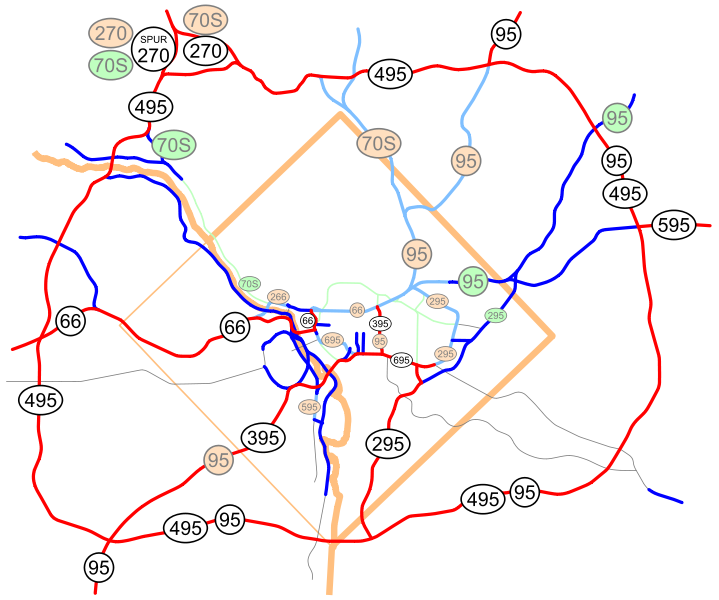
Who Really Stopped DC Freeways
http://wwwtripwithinthebeltway.blogspot.com/2008/12/who-really-stopped-washington-dcs.html

Washington D.C. Supreme Bridge NON Builder
http://wwwtripwithinthebeltway.blogspot.com/2010/09/washington-dcs-supreme-bridge-builder.html

The Hidden Power Hidden In Plain Sight
http://continuingcounterreformation.blogspot.com/2011/07/up-front-hidden-in-plain-sight.html

In The Shadow of CUA
http://wwwtripwithinthebeltway.blogspot.com/2009/10/ectcs-creation-assisted-by-roman.html

Counter Reformation
http://encyclopedia2.thefreedictionary.com/Counter-Reformation

Counter-Reformation

Catholic reaction, an ecclesiastical and political movement in Europe in the mid-16th to 17th century that was led by the papacy and that was directed against the Reformation, with the aim of restoring the position lost by Catholicism in several countries during the first half of the 16th century. In essence the Counter-Reformation was one of the manifestations of feudal reaction (embracing not only the economic and political spheres but the ideological as well), the religious form of the “counterattack” of feudal forces attempting to strengthen the feudal system at a time when it had already begun to disintegrate.

The Inquisition, monastic orders, and the Roman curia were the chief instruments of the Counter-Reformation. The Inquisition, reorganized in 1542 into one of the congregations of the Roman curia and placed under the direct authority of the pope, unleashed in the Catholic countries a struggle against progressive ideas, freethinking, science, and all manifestations of Reformation thought (popular movements in the Reformation were persecuted with particular force). G. Bruno and G. Vanini were burned at the stake, and T. Campanella, Galileo, and many other progressive thinkers were subjected to persecution.

The Jesuit Order, created in 1534—40, took the most active part in the Counter-Reformation. With the help of the Jesuits and other forces of Catholic reaction the papacy succeeded at the Council of Trent (1545–63) in obtaining, in particular, recognition of the unconditional authority of the pope in matters of faith, introduction of a strict ecclesiastical censorship, publication of the Index of Forbidden Books, and other measures. The resolutions of the council became something of a program for the Counter-Reformation. The Trent Profession of Faith was adopted, which all ecclesiastics had to sign; any deviation from it
was considered heresy and was persecuted.

During the Counter-Reformation there were created in Rome a number of educational establishments for the special training of Catholic clergymen, who were sent, above all, to the countries that were the arena for the most intense struggle between the forces of the Reformation and Counter-Reformation (such as Germany, the Netherlands). During the Counter-Reformation the Jesuits seized control of many universities, which in turn became instruments of Catholic reaction. Among the church figures who most zealously waged the Counter-Reformation were Popes Paul III, Paul IV (Cardinal Carafa prior to his election as pope), and Pius IV, as well as Cardinal Carlo Borromeo and the Jesuit P. Canisius.

The Counter-Reformation was not only the work of institutions of the Catholic Church. It was also energetically waged by the secular powers of several countries, including the Hapsburgs in Spain and the so-called Holy Roman Empire, Maximillian of Bavaria, and Sigismund III Vasa in Poland. Supporters of the Reformation were subjected to state persecution; special government edicts were issued that demanded the return of Protestants to the “bosom of the Catholic Church” under the threat of high fines, expulsion from the country, or even execution. One of the manifestations of the Counter-Reformation was the struggle for the return of lands lost by Catholics during the carrying out of the Reformation (publication of the Edict of Restitution of 1629 by Ferdinand II, emperor of the Holy Roman Empire). Under the banner of the Counter-Reformation, Spain waged its struggle against the Dutch bourgeois revolution of the 16th century, and the Hapsburgs suppressed the liberation movement of their subjugated peoples and struggled for the realization of the idea of the creation of a “universal Christian empire” (as during the Thirty Years' War of 1618–48).

Having brought together the forces of feudal reaction, the Counter-Reformation to a certain extent strengthened the position of the papacy and the Catholic Church (having restored Catholicism and suppressed Reformation movements in several countries) and temporarily retarded the onset of the forces of the new, bourgeois society.

REFERENCES
Mikhnevich, D. E. Ocherki po istorii katolicheskoi reaktsii (lezuity). Moscow, 1953.
Lozinskii, S. G. Istoriia papstva. Moscow, 1961.
Brandi, K. Deutsche Reformation und Gegenreformation. Vol. 2:
”Gegenreformation und Religionskriege.” Leipzig, 1930.
The Great Soviet Encyclopedia, 3rd Edition (1970-1979). © 2010 The Gale Group, Inc. All rights reserved.
Wednesday, August 14, 2013

Washington, D.C. War on People Shuns East of Anacostia - Massachusetts Avenue SE Bridge

Massachusetts Avenue SE Bridge - Not all of Washington D.C.'s unjust truncations are freeways

If built would make Massachusetts Avenue Washington, D.C.'s longest continuous boulevard. 

Richard Laymen to his credit has supported this bridge.

Organizations as the "Capitol Hill Restoration Society" have to their detriment opposed it.

The lack of a bridge to carry and connect Massachusetts Avenue across the Anacostia River isolates the area east of the Anacostia River, and represents a Capitol Hill snobbery that has no place in our nation's Capital.

Tuesday, July 23, 2013

Eastern Star 2013 Waste

They Were Warned.

http://wwwtripwithinthebeltway.blogspot.com/2013/01/constitutional-power-can-free-us.html 

 http://wwwtripwithinthebeltway.blogspot.com/2011/07/eastern-star-dc-i-95-chock.html


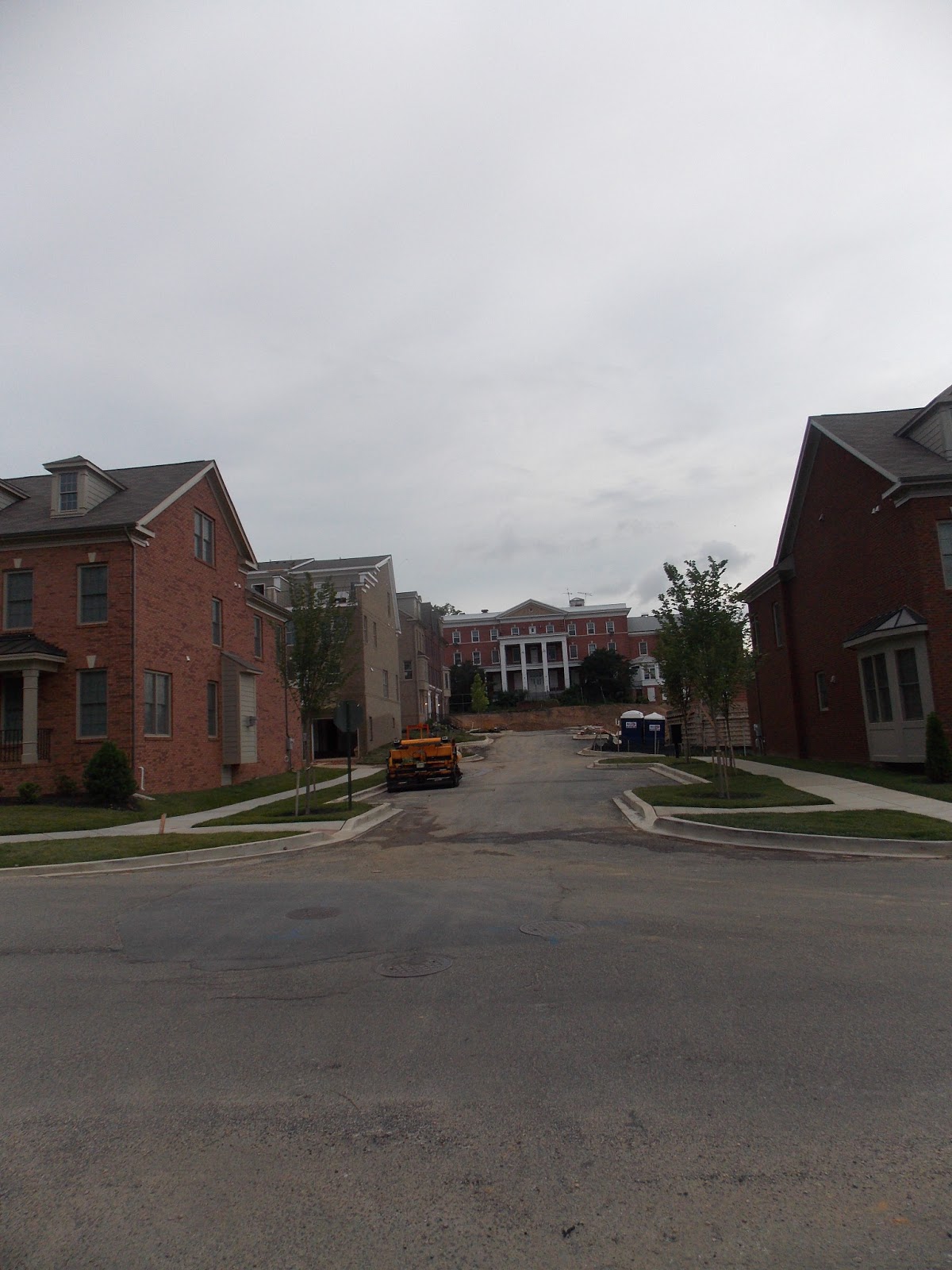
Desecration of the Eastern Star property at 6000 New Hampshire Avenue NE


Demolition Specials in the path of Washington, D.C. PEPCO-B&O I-95


This is a classic example of why eminent domain is entirely proper as a basic concept and is within the U.S. Constitution.

No one buying into this boondoggle should claim that they were not warned.


Monday, June 03, 2013

Washington, D.C. War on Drivers War on People

Ignores ultra dangerous median design for decades where it hangs one of its most profitable speed cameras

http://www.washingtonpost.com/local/trafficandcommuting/dc-puts-a-price-on-speeding-295-million/2013/05/27/56a6cb52-b357-11e2-9a98-4be1688d7d84_story.html

The $8 million box sits unmolested but detested beside a pillar in a tunnel that carries four lanes of traffic near the very heart of town. It clicks, it flashes, it clicks, it flashes....
That box and the cameras inside it have generated 61,061 speeding tickets in the past seven months, transferring $8.1 million from the wallets of K Street drivers into the District’s treasury. The cameras, which sit where four lanes of K Street dip under Washington Circle, are on pace to set a District record for cash earned by a speed camera.
If about safety, why are the cameras inside the tunnel rather than at, or pointed towards the nearest traffic light intersection at its approaches, where there are pedestrian crosswalks?

K Street Tunnel camera next to a pillar that is square edged and unshielded (no guard rail) - note the square edged design like that in Paris with the death of Lady Di in the Pont de l'Alma road tunnel.

Note the square edged design catches errant automobiles forcing rapid release-dissipation of kinetic energy (and hence increase internal injuries), rather than deflecting such with a smooth guard barrier.

IMG_2283_In the Tunnel of Princess Diana's crash, Paris by Christopher-Ch on flickr.com


Compare with this video (non embeddable) of the K Street tunnel beneath Washington Circle.


Why are such tunnel-ways not equipped with safer median designs?

Washington, D.C. behind Union Station with continuous barriers retrofitted

Other older such passages have been retrofitted with a guardrail to prevent errant vehicles from getting caught upon a column, hence better dissipating the kinetic energy, reducing injuries.

A schematic drawing provides a view of an early Jersey barrier, but offers no clues to the design’s inventor.


ICC Tunnel with continuous barrier integral to the design

At roughly $1 million monthly from the fines, how about spending some of that money upon installing a smooth continuous jersey barrier application to those square posts beneath Washington Circle?

Washington, D.C. War on Freeways War on People 
http://wwwtripwithinthebeltway.blogspot.com/2013/05/washington-dcs-war-on-freeways-war-on.html

New Jersey Median Barrier History (Scott Kozel)http://www.roadstothefuture.com/Jersey_Barrier.html


Tuesday, May 07, 2013

Washington, D.C.'s War on Freeways War on People

is all about pushing the burden disproportionately upon less affluent areas.


[does not show NW Freeway; shows NW Branch I-95 and NOT the PEPCO route]

Cancelling the Northwest Freeway (shown below, not above), and anything along the Canal Road or former trolly right of way, shifted the burden partially to Virginia's George Washington Parkway, which does not allow commercial traffic as trucks, and largely to the east.

1957 Northwest Freeway Options

1959 Northwest Freeway along Wisconsin Avenue corridor
with Glover Archbold Parkway and I-70S Cross Park Freeway


I-70S Cross Park Freeway

Cancelling the North Central - Northeast Freeway shifted the burden to the New York Avenue Industrial Freeway, which was likewise cancelled, thereby shifting the burden to D.C. 295.

 1962 B&O-Fort Drive I-95


1971 B&O-PEPCO I-95

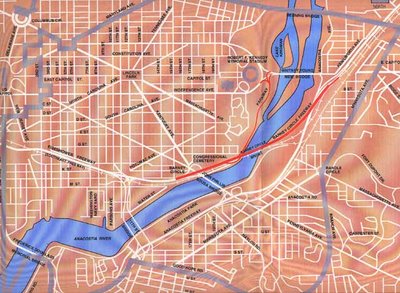
Not building the extension from the SE Freeway, particularly the cancellation of the East Leg placed the burden more upon DC 295
1961 East Leg Options


1963-1974 East Leg


1983-1996 proposed Barney Circle Connector


2013 - new 11th Street Bridges 
reinforce south of Anacostia with more of the burden, never mind the greater ease of covering the eastern portion of the SE Freeway and its Barney Circle or East Leg extension, owing to the topography, as opposed to the south of the Anacostia River Anacostia Freeway that would have to be completely reconstructed at a lower elevation in order to be covered.


Where the extra burden goes - DC 295 Anacostia Freeway

You would think these 'Powers-That-Be' that make these decisions would at least then do something to modernize and mitigate the area around Eastern Avenue and East Capitol Street of DC 295.

Rather than a 1940s design freeway built during the late 1950s with 3 narrow lanes and no shoulders in each direction, an all too short underpass beneath Eastern Avenue, and in a configuration around East Capitol Street utterly at architectural odds with what one would expect from the Nation's CapitAl, give it a set of cut and cover tunnels with the extra capacity and safety shoulders.  Then demolish existing elevated D.C. 295, and extend the cut and cover treatment through the interchange with Pennsylvania Avenue SE with either a circle or an oval

The authorities have given some lip service to this in planning documents as U.S.N.C.P.C.'s Extending the Legacy- Planning America's Capital for the 21st Century.

So far, D.C. officials plan to modernize its northern segment, though as an open trench and not a cut and cover tunnel.

Could not a legal case be made that Washington, D.C.'s cancellation of its north of the Anacostia River freeways places a disproportionate amount of the traffic burden to the less affluent areas to the south of the Anacostia River?

Washington D.C. The War On Freeways
http://wwwtripwithinthebeltway.blogspot.com/2013/04/the-war-on-freeways.html