'transit' center boondoggle
http://articles.washingtonpost.com/2012-01-11/local/35438858_1_transit-center-transit-hub-county-officials
http://greatergreaterwashington.org/post/18134/silver-spring-transit-center-is-unsafe-everyones-to-blame/
It is good that such a poorly conceived project gets subverted by poor workmanship- which perhaps should be taken as a hint that the Sarbanes transit center is simply a bad idea, not very needed and badly placed in the path of what is needed, a B&O corridor North Central Freeway.
Thursday, March 21, 2013


Thursday, February 14, 2013
Obama's Mis-Direct
From an interview with U.S. President Obama
What Obama says above sounds reasonable, though he needs to also apply it to the Democrats.
You'd think that the Democrats would have say defended the plan promoted by John F. Kennedy, for the B&O Route North Central Freeway. At least protected it against such a botching with the route deviations in Brookland D.C. and especially in Takoma Park, Maryland; with a report ordered in late 1962-early 1963, yet delayed a year and half; a report that disregarded the main idea of the November 1962 report for the I-70S/I-95 North Central Freeway to hug the B&O railroad that was built a century earlier: a botching just prior to and following the assassination of November 22, 1963, to keep I-95 far away from Catholic University of America, yet lingering so long un-illuminated.
Why after all, are both parties too chickenshit to dare propose completing I-95 through Washington. Nor the I-66 crosstown tunnel under K Street that had been promoted by opponents to the 1950s plan for an open trench freeway along Florida Avenue and U Street?
http://www.rollingstone.com/politics/news/ready-for-the-fight-rolling-stone-interview-with-barack-obama-20120425?print=true
[excerpt] Is there any way to break through that obstructionism by Republicans?How ironic, when neither party seems capable of completing say I-95 though Washington D.C.- allowing it to be hijacked for a typically overly simplistic and misleading 'no white mans roads through black mans homes' even with the available existing right of ways requiring displacing but a small fraction than assumed, comparable with that deemed acceptable for the Capital Beltway widening through Alexandria, Virginia, Springfield, and in Maryland for the Inter County Connector.
My hope is that if the American people send a message to them that's consistent with the fact that Congress is polling at 13 percent right now, and they suffer some losses in this next election, that there's going to be some self-reflection going on – that it might break the fever. They might say to themselves, "You know what, we've lost our way here. We need to refocus on trying to get things done for the American people."
Frankly, I know that there are good, decent Republicans on Capitol Hill who, in a different environment, would welcome the capacity to work with me. But right now, in an atmosphere in which folks like Rush Limbaugh and Grover Norquist are defining what it means to be a true conservative, they are lying low. My hope is that after this next election, they'll feel a little more liberated to go out and say, "Let's redirect the Republican Party back to those traditions in which a Dwight Eisenhower can build an interstate highway system."
What Obama says above sounds reasonable, though he needs to also apply it to the Democrats.
You'd think that the Democrats would have say defended the plan promoted by John F. Kennedy, for the B&O Route North Central Freeway. At least protected it against such a botching with the route deviations in Brookland D.C. and especially in Takoma Park, Maryland; with a report ordered in late 1962-early 1963, yet delayed a year and half; a report that disregarded the main idea of the November 1962 report for the I-70S/I-95 North Central Freeway to hug the B&O railroad that was built a century earlier: a botching just prior to and following the assassination of November 22, 1963, to keep I-95 far away from Catholic University of America, yet lingering so long un-illuminated.
Why after all, are both parties too chickenshit to dare propose completing I-95 through Washington. Nor the I-66 crosstown tunnel under K Street that had been promoted by opponents to the 1950s plan for an open trench freeway along Florida Avenue and U Street?
Wednesday, January 23, 2013
Constitutional Power Can Free Us
Especially Appropriate for Freeing Right of Way For PUBLIC USE from PRIVATE development


The Supreme Court has held that the federal government and each state has the power of eminent domain—the power to take private property for "public use". The Takings Clause,
the last clause of the Fifth Amendment, limits the power of eminent
domain by requiring that "just compensation" be paid if private property
is taken for public use. The just compensation provision of the Fifth
Amendment did not originally apply directly to the states, but since Chicago, B. & Q. Railroad Co. v. Chicago (1897), federal courts have held that the Fourteenth Amendment
extended the effects of that provision to the states. The federal
courts, however, have shown much deference to the determinations of
Congress, and even more so to the determinations of the state
legislatures, of what constitutes "public use". The property need not
actually be used by the public; rather, it must be used or disposed of
in such a manner as to benefit the public welfare or public interest.
One exception that restrains the federal government is that the property
must be used in exercise of a government's enumerated powers.
The owner of the property that is taken by the government must be justly compensated. When determining the amount that must be paid, the government does not need to take into account any speculative schemes that the owner claims the property was intended for use in. Normally, the fair market value of the property determines "just compensation". If the property is taken before the payment is made, interest accrues (though the courts have refrained from using the term "interest").
The federal courts have not restrained state and local governments from seizing privately owned land for private commercial development on behalf of private developers. This was upheld on June 23, 2005, when the Supreme Court issued its opinion in Kelo v. City of New London. This 5–4 decision remains controversial.
The majority opinion, by Justice Stevens, found that it was appropriate to defer to the city's decision that the development plan had a public purpose, saying that "the city has carefully formulated a development plan that it believes will provide appreciable benefits to the community, including, but not limited to, new jobs and increased tax revenue." Justice Kennedy's concurring opinion observed that in this particular case the development plan was not "of primary benefit to . . . the developer" and that if that was the case the plan might have been impermissible.
In the dissent, Justice Sandra Day O'Connor argued that this decision would allow the rich to benefit at the expense of the poor, asserting that "Any property may now be taken for the benefit of another private party, but the fallout from this decision will not be random. The beneficiaries are likely to be those citizens with disproportionate influence and power in the political process, including large corporations and development firms." She argued that the decision eliminates "any distinction between private and public use of property—and thereby effectively delete[s] the words 'for public use' from the Takings Clause of the Fifth Amendment".
A number of states, in response to Kelo, have passed laws and/or state constitutional amendments which make it more difficult for state governments to seize private land. Takings that are not "for public use" are not directly covered by the doctrine,[62] however such a taking might violate due process rights under the Fourteenth amendment, or other applicable law.
'ArtSpace' Demolition Special
http://wwwtripwithinthebeltway.blogspot.com/2013/01/artsspace-cua-chock-continued.html
Ribbon cutting on real estate development project
by Comstock Homes - "The Hampshires"
by Comstock Homes - "The Hampshires"
built in contempt of the D.C. I-95 public right of way
former open field between major power line - retail and railroad corridors
Buyers were warned about logical eminent domain situation

Buyers were warned about logical eminent domain situation
http://wwwtripwithinthebeltway.blogspot.com/2011/07/eastern-star-dc-i-95-chock.html
http://wwwfreespeechbeneathushs.blogspot.com/2011/08/internet-censorship-test.html
The Hampshires, a new community of 111 single family homes and town homes being developed by Comstock in the Lamond-Riggs neighborhood of Northeast Washington, DC. City Councilperson Muriel Bowser led the ribbon cutting ceremony; "I am delighted to welcome the Hampshire's to Ward 4, this new construction will offer much needed high quality and diverse housing. I am proud to have worked with local leaders and residents to help make this development a reality, for which residents have long clamored. I look forward to welcoming new residents to Ward 4." jj
http://ir.comstockhomes.com/common/mobile/iphone/releasedetail.cfm?ReleaseID=710774&CompanyID=ABEA-292E6R&MobileID=

I-95 PEPCO
Eminent domain
http://en.wikipedia.org/wiki/Fifth_Amendment_to_the_United_States_Constitution
Main article: Eminent domain
The owner of the property that is taken by the government must be justly compensated. When determining the amount that must be paid, the government does not need to take into account any speculative schemes that the owner claims the property was intended for use in. Normally, the fair market value of the property determines "just compensation". If the property is taken before the payment is made, interest accrues (though the courts have refrained from using the term "interest").
The federal courts have not restrained state and local governments from seizing privately owned land for private commercial development on behalf of private developers. This was upheld on June 23, 2005, when the Supreme Court issued its opinion in Kelo v. City of New London. This 5–4 decision remains controversial.
The majority opinion, by Justice Stevens, found that it was appropriate to defer to the city's decision that the development plan had a public purpose, saying that "the city has carefully formulated a development plan that it believes will provide appreciable benefits to the community, including, but not limited to, new jobs and increased tax revenue." Justice Kennedy's concurring opinion observed that in this particular case the development plan was not "of primary benefit to . . . the developer" and that if that was the case the plan might have been impermissible.
In the dissent, Justice Sandra Day O'Connor argued that this decision would allow the rich to benefit at the expense of the poor, asserting that "Any property may now be taken for the benefit of another private party, but the fallout from this decision will not be random. The beneficiaries are likely to be those citizens with disproportionate influence and power in the political process, including large corporations and development firms." She argued that the decision eliminates "any distinction between private and public use of property—and thereby effectively delete[s] the words 'for public use' from the Takings Clause of the Fifth Amendment".
A number of states, in response to Kelo, have passed laws and/or state constitutional amendments which make it more difficult for state governments to seize private land. Takings that are not "for public use" are not directly covered by the doctrine,[62] however such a taking might violate due process rights under the Fourteenth amendment, or other applicable law.
'ArtSpace' Demolition Special
http://wwwtripwithinthebeltway.blogspot.com/2013/01/artsspace-cua-chock-continued.html
Tuesday, January 22, 2013
ArtsSpace - CUA Chock Continued ...
Impedes the right of way along the western side of the B&O Metropolitan Branch Red Line Corridor, blocking the south-bound lanes of D.C. I-95 via the Grand Arc design
Pictures from Beyond D.C. http://beyonddc.com/log/?p=4331


Arts Walk D.C. I-95 Grand Arc Chock
http://wwwtripwithinthebeltway.blogspot.com/2012/02/artsspace-chock.html
Pictures from Beyond D.C. http://beyonddc.com/log/?p=4331


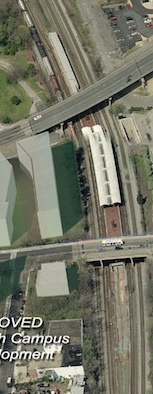
Arts Walk right of way violation
Riverside Drive extension with future NY West Side Highway Tunnel -
technology suitable for the Washington D.C. I-95 Grand Arc project segment alongside CU, with southbound tunnel lanes beneath John McCormack Drive and through Arts Walk
Arts Walk D.C. I-95 Grand Arc Chock
http://wwwtripwithinthebeltway.blogspot.com/2012/02/artsspace-chock.html
Monday, December 10, 2012
11th Street Bridge Project Stresses Need to Improve - Bury DC 295 and Connections to Route 50
This December 7, 2012, having the opportunity to drive with my Dad from New York to Williamsburg and Jamestown Virginia, drove through Washington, D.C. via the Baltimore-Washington Parkway to the new 11th Street Bridge connection to the SE/SW Freeway.
That only renewed my astonishment of the lack of comprehensive planning to update the antiquated DC 295 Kennilworth Avenue Freeway,( to say nothing for now about the lack of grace of the approaches of the replacement 11th Street bridges, more appropriate in style to my eye to someplace other than Washington, D.C).
Think about the 1983-1996 Barney Circle Freeway Bridge proposal, with the wealthier neighborhood northwest of the Anacostia River avoiding a brief freeway extension (despite the topography allowing it to be covered). And think about DC295, making even more of a wall from the waterfront to the neighborhoods to the southeast of the river, representing impact deferred being impact increased.

The new 11th Street Bridges project completes the connection between the SW/SE Freeway and DC 295 to and from the northeast, and hence is going to increase traffic upon DC 295 Kenilworth Avenue Freeway.
So what's being planned?
A new undergrounded segment beneath a new traffic circle or oval at Pennsylvania Aveune.
A newly widened and lenthened trench at and near Eastern Boulevard.
Nothing from either the feds nor D.C. for anything further, eg. replacing the segment in the vicinity of East Capitol Street beneath an artisically designed lid for extending and enhancing the L'Fant plan axis east. Not since the 1990s with USNCPC's 'Extending the Legacy' program.
I say entirely replace it with an 8 lane interstate specification grade cut and coverway with full 12 foot lanes and shoulders. Start the new excavation alongside the existing freeway. And be damn well sure to make sure that new real estate development is not built too close that would intrude upon the widening requirements.
Thursday, November 29, 2012
Sam Smith- Elitism in DC anti-automobile policies
I lived in DC most of my life and became used to ethnic conflict, class conflict, neighborhood vs. downtown conflict, geographic conflict, but now there's a new aura of conflict, described below by two of the city's most perceptive journalists. There is one thing this conflict has in common with previous ones: power calls the shots. - Sam Smith
Courtland Milloy, Washington Post - As an increasingly elite D.C. begins walling itself off from the masses, the rough outline of an architecturally restored yet soulless city emerges. Red-lined school boundaries around wealthy neighborhoods keep out less-privileged students. Closed streets and parking restrictions make for a “walkable city.” For the low-income resident who must travel longer distances to get to work and stores, a better description would be “trudge town.”
In the new D.C., the rich take a stroll. The poor take a hike.
No middle school students from outside the Wilson [High School] boundary were accepted this year, raising the specter of a “new line between educational haves and have-nots,” wrote [Ken] Archer, chief technical officer of a software firmwho lives in Georgetown.
You’d hope that striving for the common good wouldcontinue through a building boom, that the economic gap among District residents wouldn’t grow so wide that the well-to-do would lose sight of those on the other side.
“What I think is missing is a vision of what we can do to preserveaffordable housing, maintain diversity by helping those who are struggling to stay in the city as housing costs go up,” said Ed Lazere, executive director of the D.C. Fiscal Policy Institute. “The number of families with children in the city is going down, and they are largely African American families, low- and moderate-income families who aren’t just moving to other parts of town but actually leaving the city.”
... “If there is one system that serves rich neighborhoods, and another serving the poor neighborhoods, would well-meaning parents in the wealthier and more politically powerful neighborhoods lobby for morefunding for traditional public education and inadvertently disadvantage less affluent areas?”Archer wrote on the Greater Greater Washington blog. “Or would politicians from the poorer wards of the District end up opposing DCPS’s needs? A battle for resources between the haves and have-nots is not what we need, regardless of how it turns out.”
District officials recently announced a plan to promote bicycling and mass transit, with changes that could affect 10,000 parking spaces. How about making the creation of 10,000 decent-paying jobs for working-poor residents more of a priority?
“That is the sign of the future. That discourages car ownership,” said D.C. Council member Jim Graham (D-Ward 1), referring to the aggressive campaign against parking spaces.
Meanwhile, the basic rush-hour fare for a Metro bus and rail ride is up to $1.60 and $2.10, respectively, making public transportation more expensive than some car trips.
“Stay out.” That’s what the sign of the future really says.
Gary Imhoff, DC Watch - We don’t like suburbanites; we don’t want them coming into the city; we don’t want them to patronize our shops or work in our businesses. If they must come here, they should leave their cars at home and take the subway or buses or, better yet, bicycle or walk. That’s healthier and more environmentally correct, anyway.
Those are the messages sent by the Washingtonians in the more than four hundred comments to Sunday’s Washington Post article by Tim Craig, "DC Implementing Parking Rules to Limit Visitor Spots, Discourage Driving,"
Here are the first sentences of the article: "District officials are reserving thousands of on-street parking spaces for residents on weekdays in the city’s most crowded neighborhoods, part of an aggressive effort to limit spots for visitors. The restrictions are a slice of a city strategy to promote bicycling and mass transit while increasing the odds that residents can find parking. The changes, which could affect as many as 10,000 spaces, come as the city eliminates some on-street parking to make room for bicycle lanes and prepares to set aside hundreds of meters for the disabled .... Angelo Rao, manager of the District’s parking and streetlightprogram, "said the new revisions, which will affect as many as twenty parking spaces per city block, are driven both by residents’ concerns about a lack of on-street parking and a broader city policy to encourage less vehicle traffic."
... Is this the way to market DC to new residents or potential new businesses? Is this even thinking about Washington constructively as what political leaders claim tobelieveis "one city"? Divide the city into eight wards, and deliberately make it difficult for people who live in any of the wards to have guests, visitors, or workers who come from any of the other wards? If you shop for something bigger than you can carry in your arms as you walk, or bigger than you can fit in your bike’s basket, you should drive to Maryland or Virginia so you can shop in a store where you can park?
If you’re young and healthy, or if you’re alone in life, you’re welcome in the city. As long as you’regrocery shopping for yourself alone, and can fit what you buy into your bicycle basket, you’re welcome to live here. If you do a weekly grocery shopping for a family of four, move out of town. We don’t want you and your and your cancer-producing automobile here. Earlier this month, Zoning Commission Chairman Anthony Hood made the commonsense observation that, "Some of us who are riding bikes now will not be riding bikes later. And then also, we need to make sure we balance the development we do in this city for all, ’cause I haven’t seen too many people go to the grocery store and come back with their groceries on a bicycle," He was mocked by people who said that, of course, they carried theirgrocerieson their bicycles. These are people who see their lifestyle, their current lifestyle, as the normal, natural way that everyone should live, and are scornful of anyone who would actually buy provisions for an entire family.
If you’re running a business that requires patronage from more than the fifteen thousand people or so who live in your immediate neighborhood, take your business to the suburbs. If your employees want to drive to their work instead of spending hours a day on public transportation, take your business to the suburbs. This city’s planners have decided that it should be only for young, wealthy, single hipsters. Families and old people and people who have friends in distant neighborhoods aren’t welcome. They may as well be suburbanites.
Courtland Milloy, Washington Post - As an increasingly elite D.C. begins walling itself off from the masses, the rough outline of an architecturally restored yet soulless city emerges. Red-lined school boundaries around wealthy neighborhoods keep out less-privileged students. Closed streets and parking restrictions make for a “walkable city.” For the low-income resident who must travel longer distances to get to work and stores, a better description would be “trudge town.”
In the new D.C., the rich take a stroll. The poor take a hike.
No middle school students from outside the Wilson [High School] boundary were accepted this year, raising the specter of a “new line between educational haves and have-nots,” wrote [Ken] Archer, chief technical officer of a software firmwho lives in Georgetown.
You’d hope that striving for the common good wouldcontinue through a building boom, that the economic gap among District residents wouldn’t grow so wide that the well-to-do would lose sight of those on the other side.
“What I think is missing is a vision of what we can do to preserveaffordable housing, maintain diversity by helping those who are struggling to stay in the city as housing costs go up,” said Ed Lazere, executive director of the D.C. Fiscal Policy Institute. “The number of families with children in the city is going down, and they are largely African American families, low- and moderate-income families who aren’t just moving to other parts of town but actually leaving the city.”
... “If there is one system that serves rich neighborhoods, and another serving the poor neighborhoods, would well-meaning parents in the wealthier and more politically powerful neighborhoods lobby for morefunding for traditional public education and inadvertently disadvantage less affluent areas?”Archer wrote on the Greater Greater Washington blog. “Or would politicians from the poorer wards of the District end up opposing DCPS’s needs? A battle for resources between the haves and have-nots is not what we need, regardless of how it turns out.”
District officials recently announced a plan to promote bicycling and mass transit, with changes that could affect 10,000 parking spaces. How about making the creation of 10,000 decent-paying jobs for working-poor residents more of a priority?
“That is the sign of the future. That discourages car ownership,” said D.C. Council member Jim Graham (D-Ward 1), referring to the aggressive campaign against parking spaces.
Meanwhile, the basic rush-hour fare for a Metro bus and rail ride is up to $1.60 and $2.10, respectively, making public transportation more expensive than some car trips.
“Stay out.” That’s what the sign of the future really says.
Gary Imhoff, DC Watch - We don’t like suburbanites; we don’t want them coming into the city; we don’t want them to patronize our shops or work in our businesses. If they must come here, they should leave their cars at home and take the subway or buses or, better yet, bicycle or walk. That’s healthier and more environmentally correct, anyway.
Those are the messages sent by the Washingtonians in the more than four hundred comments to Sunday’s Washington Post article by Tim Craig, "DC Implementing Parking Rules to Limit Visitor Spots, Discourage Driving,"
Here are the first sentences of the article: "District officials are reserving thousands of on-street parking spaces for residents on weekdays in the city’s most crowded neighborhoods, part of an aggressive effort to limit spots for visitors. The restrictions are a slice of a city strategy to promote bicycling and mass transit while increasing the odds that residents can find parking. The changes, which could affect as many as 10,000 spaces, come as the city eliminates some on-street parking to make room for bicycle lanes and prepares to set aside hundreds of meters for the disabled .... Angelo Rao, manager of the District’s parking and streetlightprogram, "said the new revisions, which will affect as many as twenty parking spaces per city block, are driven both by residents’ concerns about a lack of on-street parking and a broader city policy to encourage less vehicle traffic."
... Is this the way to market DC to new residents or potential new businesses? Is this even thinking about Washington constructively as what political leaders claim tobelieveis "one city"? Divide the city into eight wards, and deliberately make it difficult for people who live in any of the wards to have guests, visitors, or workers who come from any of the other wards? If you shop for something bigger than you can carry in your arms as you walk, or bigger than you can fit in your bike’s basket, you should drive to Maryland or Virginia so you can shop in a store where you can park?
If you’re young and healthy, or if you’re alone in life, you’re welcome in the city. As long as you’regrocery shopping for yourself alone, and can fit what you buy into your bicycle basket, you’re welcome to live here. If you do a weekly grocery shopping for a family of four, move out of town. We don’t want you and your and your cancer-producing automobile here. Earlier this month, Zoning Commission Chairman Anthony Hood made the commonsense observation that, "Some of us who are riding bikes now will not be riding bikes later. And then also, we need to make sure we balance the development we do in this city for all, ’cause I haven’t seen too many people go to the grocery store and come back with their groceries on a bicycle," He was mocked by people who said that, of course, they carried theirgrocerieson their bicycles. These are people who see their lifestyle, their current lifestyle, as the normal, natural way that everyone should live, and are scornful of anyone who would actually buy provisions for an entire family.
If you’re running a business that requires patronage from more than the fifteen thousand people or so who live in your immediate neighborhood, take your business to the suburbs. If your employees want to drive to their work instead of spending hours a day on public transportation, take your business to the suburbs. This city’s planners have decided that it should be only for young, wealthy, single hipsters. Families and old people and people who have friends in distant neighborhoods aren’t welcome. They may as well be suburbanites.
Wednesday, August 22, 2012
Get really serious with Washington, D.C.'s Union Station

Craft the Corridor into the Grand Arc
A landscaped terraced linear park atop a primarily underground railway and highway
Would allow expanding the railways
Would include the primarily underground extension of I-395 to a continuation to I-95 via a tunnel alongside New Hampshire Avenue to the PEPCO power line corridor.
Would include above grounding the Tiber Creek to a point just south of New Yor Avenue

Craft the Corridor into the Grand Arc
A landscaped terraced linear park atop a primarily underground railway and highway
Would allow expanding the railways
Would include the primarily underground extension of I-395 to a continuation to I-95 via a tunnel alongside New Hampshire Avenue to the PEPCO power line corridor.
Would include above grounding the Tiber Creek to a point just south of New Yor Avenue
Subscribe to:
Posts (Atom)